
Could a skip bin look half-full and still be too heavy? Working out how to estimate rubbish volume for skip bin hire takes more than eyeballing a pile. Irregular shapes, gaps between bulky items and dense materials such as soil or concrete can all affect how useful your estimate is.
If you’re planning a home clear-out, garden tidy-up or building project, choosing a bin that’s too small can disrupt the job, while more space than you need may not be the right fit either. Measuring the waste gives you a practical starting point. A few adjustments for its shape and material can make the estimate more realistic.
This guide explains how to measure a rubbish pile and calculate its volume in cubic metres, account for awkward shapes and mixed materials, and check your result before choosing a skip bin. Volume isn’t the whole story: heavy waste can reach a bin’s weight limit before it fills the available space. A clearer estimate helps you plan your Sydney project with less guesswork.
Key Takeaways
- Estimate rubbish volume for skip bin hire by measuring each pile and adding the cubic-metre totals.
- Convert centimetres to metres before calculating, so all measurements use consistent units.
- Account for bulky shapes and dense materials, as piles of equal volume can have very different weights.
- Sort waste and remeasure uneven piles to make your estimate more dependable.
- Use your volume estimate, waste type and loading access to guide a suitable skip bin choice for your Sydney project.
Why estimate rubbish volume before booking a skip bin?
Rubbish volume is the three-dimensional space your waste occupies, measured in cubic metres (m³). Estimating it before booking gives you a more practical starting point for matching skip bin capacity to a home clear-out, garden tidy-up or construction clean-up. It replaces a quick visual guess with measurements you can compare and refine.
Volume is only one part of the decision. Waste type affects the load’s weight, while the shape of the pile and the way you load it affect how efficiently you use the bin. Treat your estimate as a planning guide, not a guarantee of the final load. The result may change as you sort, stack or add rubbish.
What does cubic metre mean for a skip bin?
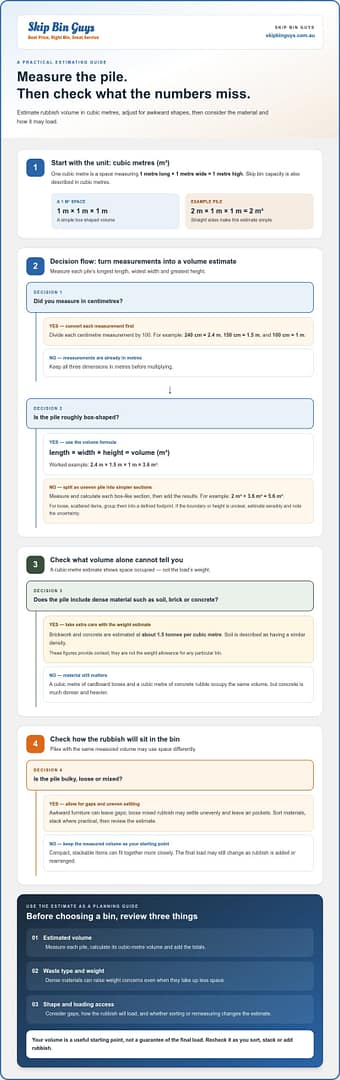
One cubic metre is a space measuring one metre long, one metre wide and one metre high. Picture a box with those dimensions: its capacity is 1 m³. Skip bin capacity is also described in cubic metres, so estimating your rubbish in the same unit gives you a useful basis for comparison. For a clear explanation of the unit, see Understanding the Cubic Metre.
For example, a box-shaped pile measuring 2 metres long, 1 metre wide and 1 metre high occupies 2 m³. This simple example assumes straight sides. An uneven pile needs a more considered estimate.
Why a good estimate makes project planning easier
Measuring early helps you picture how much space your rubbish is likely to occupy and plan the clean-up with fewer surprises. A glance can be misleading: loose branches may spread out, while furniture can leave gaps between items. Piles that look similar from the front may also differ in depth.
To estimate rubbish volume for skip bin hire, follow a consistent process: measure each pile, calculate its volume, adjust for its shape and consider the material. Then review the total as a guide to capacity, bearing in mind that dense materials can raise weight concerns even when they take up less space. Start by measuring the piles.
How to calculate rubbish volume in cubic metres
Use the formula length × width × height = volume. Measure each dimension in metres, then multiply the numbers to estimate the space the pile occupies. The result is in cubic metres (m³), the same unit used to describe skip bin capacity.
If you’ve measured in centimetres, convert each measurement to metres first by dividing by 100. For example, 240 cm becomes 2.4 m, 150 cm becomes 1.5 m and 100 cm becomes 1 m. Convert all three dimensions before multiplying so your result is in cubic metres.
Measure a regular pile with a tape measure
For a neat, box-shaped pile, measure its outside dimensions: the longest length, widest width and greatest height. Measure the pile as a whole rather than estimating each item inside it. Write all three measurements in metres, then calculate the volume.
Worked example: A pile is 240 cm long, 150 cm wide and 100 cm high. Convert the measurements, then calculate: 2.4 m × 1.5 m × 1 m = 3.6 m³. The pile’s estimated volume is 3.6 cubic metres.
Estimate irregular rubbish as smaller shapes
Long or uneven piles can be difficult to measure as one block. Divide them into simpler, box-like sections, measure each section and calculate its volume separately. Add the results for a combined estimate. For instance, two sections measuring 2 m³ and 3.6 m³ have a total estimated volume of 5.6 m³.
For loose, scattered items, group them into a defined footprint before measuring. If the boundary or height is unclear, make a sensible estimate and note the uncertainty so you can review it later.
These calculations estimate space, not weight. Materials with the same volume can weigh very differently, so don’t use cubic metres alone to judge a heavy load. The US EPA’s EPA Guidelines on Waste Volume-to-Weight Conversion illustrate how conversion factors vary by waste type. Treat them as a general reference, not a Sydney bin weight limit.
Once you’ve measured and totalled your piles, use the result as a starting point for planning. Consider the rubbish type and the space available for loading as you explore skip bin hire in Sydney.
Why rubbish type, shape and weight can change your estimate
A volume estimate tells you how much space a pile occupies, not how heavy it is. That distinction matters because a load can take up modest space yet weigh far more than a pile of bulky, lightweight items. For skip bin planning, consider both the material and how it will sit in the bin.
Volume is not the same as weight
Compare a cubic metre of cardboard boxes with a cubic metre of concrete rubble. They occupy the same volume, but concrete is much denser and heavier. Brickwork and concrete are estimated at about 1.5 tonnes per cubic metre. Soil is also described as having a similar density. These figures provide context, not the weight allowance for any particular bin.
Rubble, soil and concrete therefore need extra care in your estimate. Measuring the pile helps you understand the space it occupies, but a volume-only calculation may not tell you whether a heavy load is suitable. Keep the material type clear as you plan, especially if the clean-up includes a substantial amount of dense waste.
Account for bulky, compact and mixed rubbish
Shape affects how efficiently you can use bin space. A bulky armchair or awkward piece of furniture may leave large gaps around it, so a small-looking pile can take up more capacity than expected. Compact, stackable items can fit together more closely, while loose mixed rubbish may settle unevenly and leave air pockets. Your measured pile is a starting point, not a perfect picture of how it will load.
Sorting materials before measuring helps you distinguish separate waste types and make your estimate more useful. It also makes the contents easier to identify. Don’t assume every item belongs in the same skip bin: hazardous waste and liquid waste need separate handling and aren’t ordinary skip-bin contents.
Green waste can also behave differently from compact household items. Branches and prunings are awkward to stack and may leave gaps. If that’s your main waste stream, the Green Waste Skip Bin Sydney guide can help you plan for a garden project.
As you refine your estimate, note what the rubbish is made of as well as its approximate volume. This gives you a clearer picture of the space required and the type of load you’re planning, without treating cubic metres as a substitute for weight or material considerations.
A practical checklist for checking your rubbish volume estimate
Before choosing a skip bin, review your calculations and the waste you plan to load. A quick check can catch missed piles, inconsistent measurements or material types that may affect your hire choice. Work through this sequence:
- Sort the waste. Group similar materials and separate items that need different handling. For renovation or construction work, identify timber, packaging and rubble rather than treating everything as one general pile.
- Measure each pile. Record its length, width and height in metres. If a pile has uncertain boundaries or an unusually uneven shape, divide it into simpler sections or measure it again.
- Calculate each volume. Multiply the three measurements for each pile, then record the result in cubic metres.
- Add the sections once. Total the separate pile estimates, checking that you haven’t counted any section twice or left one out.
- Review capacity and material. Compare your total with the capacity options available for the job, and consider the waste type as well as the volume.
Run through the estimate before choosing a bin
Check that you’ve recorded all three dimensions in metres for every pile. Then scan your notes: have you included each area of rubbish once, and only once? This simple audit is especially useful when waste is spread across a garage, yard or worksite. Your final cubic-metre total gives you a clearer basis for comparing capacity options, while the material category puts that figure in context.
For building or renovation clean-ups, the type of debris matters alongside the total space it occupies. The Construction Skip Bin Hire Sydney guide offers project-specific context for construction waste. For a household clear-out, the Residential Skip Bin Hire Sydney: The Complete 2026 Homeowner’s Guide is a relevant companion.
Allow for uncertainty without guessing a percentage
Some piles are difficult to measure precisely. Loose items may spread beyond a clear footprint, while irregular shapes can make the height or edge uncertain. Rather than adding an unsupported buffer percentage, record your assumption. For example, note that you measured the widest part of the pile or estimated its average height. Remeasure if that uncertainty could materially change your total.
Knowing how to estimate rubbish volume for skip bin selection gives you a useful planning figure, not a promise of the final load. Once you’ve checked the measurements and material, use your estimate to guide your Sydney project’s hire choice. Explore skip bin hire options for your project.
Turn your estimate into a suitable Sydney skip bin hire choice
Your cubic-metre estimate is a useful starting point, but a suitable hire choice also depends on what you’re throwing out, where the project is and how the bin can be loaded. A renovation pile of compact rubble calls for different planning from a household clear-out containing bulky furniture, even if both estimates show a similar volume.
Bring those details together before arranging hire. Skip Bin Guys provides residential, commercial and construction skip bin hire across Sydney. With more than 13 years of experience, the team can help you use your estimate to work towards an option that fits the project. Skip Bin Guys uses EPA-approved recycling yards to maximise material recovery.
What to have ready when arranging skip bin hire
A short, clear project brief makes it easier to turn your estimate into a practical hire choice. Have these details ready:
- Project and location: Describe the job, such as a home clean-out, garden tidy-up or building project, and give the Sydney suburb.
- Estimated volume and materials: Share your total in cubic metres and name the main waste types.
- Load details: Mention whether the rubbish includes bulky items, dense material or a mixture, as these can affect how the load fits and weighs.
- Placement and access: Describe where you’d like the bin placed and the access available for delivery, including any tight or restricted areas.
Clear details keep the discussion grounded in your actual job rather than a volume figure on its own. If your estimate is uncertain, explain what makes it difficult, such as loose material or an uneven pile.
Get local help turning the estimate into a hire choice
It’s normal to have questions once you’ve measured everything. The Skip Bin Guys team can help you think through the estimate, waste type and site details as part of the hire process. Same-day delivery is available for orders placed before 10:30 am.
Now that you’ve worked through how to estimate rubbish volume for skip bin hire, you can take the next step with a clearer picture of your project. Explore Skip Bin Guys skip bin hire for your Sydney clean-up, renovation or worksite.
Put your estimate to work on your Sydney project
A measured estimate gives you a clearer starting point for choosing skip bin capacity. Use length × width × height to calculate cubic metres, then total separate piles. Before deciding, consider how bulky or awkwardly shaped items may leave gaps, and remember that dense materials can weigh more than their volume suggests.
That’s the practical approach to estimating rubbish volume for skip bin hire: measure the space, identify the materials and treat the result as a planning guide. Your project location and loading access also help shape a suitable hire choice.
Skip Bin Guys brings more than 13 years of experience to residential, commercial and construction skip bin hire across Sydney. The team uses EPA-approved recycling yards to maximise material recovery and support responsible waste handling.
Ready to take the next step? Arrange skip bin hire for your Sydney project and move ahead with a clearer plan. You’ve done the measuring; now you can organise your clean-up with greater confidence.
Frequently Asked Questions
How do I calculate rubbish volume for a skip bin?
Measure the rubbish pile’s length, width and height in metres, then multiply those measurements: length × width × height = cubic metres. For example, a pile measuring 2 m long, 1.5 m wide and 1 m high is 3 m³. For separate piles, calculate each one independently and add the results. To estimate rubbish volume for skip bin planning, measure the overall piles rather than individual objects.
What is a cubic metre when choosing a skip bin?
A cubic metre (m³) is the space inside a cube that measures 1 m long, 1 m wide and 1 m high. Skip bin capacity is commonly expressed in cubic metres, so estimating your rubbish in this unit gives you a useful way to compare the job with available capacity. Remember, the measurement describes space, not weight. A cubic metre of bulky items can weigh far less than the same volume of dense material.
How do I estimate the volume of an irregular rubbish pile?
Break an irregular pile into smaller, box-like sections that are easier to measure. Work out the length, width and height of each section, calculate its volume, then add the results. For loose items, group them within a clear footprint before measuring. If the edges or height are hard to judge, record your assumptions and remeasure the pile where you can. This makes your total more useful without suggesting it is exact.
Should I choose a skip bin based on volume or weight?
Consider both. Volume tells you how much space the rubbish occupies, while weight depends on the material. Bulky items may take up plenty of room but remain relatively light; compact rubble, soil or concrete can be heavy even if the pile looks small. Use your cubic-metre estimate alongside the material type, especially for dense loads. A volume calculation alone can’t establish whether a heavy load is suitable for a particular bin.
How much extra space should I allow when estimating rubbish?
There isn’t one extra-space figure that suits every pile, so avoid adding an arbitrary percentage. Bulky objects, loose rubbish and awkward shapes can leave air gaps or make the pile hard to measure. Instead, note where your estimate is uncertain, divide uneven piles into simpler sections and remeasure if needed. Also consider how the rubbish is likely to be loaded, since a measured pile may pack differently once items are placed together.
Can I put mixed renovation rubbish in a skip bin?
Don’t assume every renovation material belongs in the same load. First identify and sort the main materials, such as timber, metal or rubble, then consider their different space and weight characteristics. Hazardous and liquid waste need separate handling and shouldn’t be treated as ordinary skip bin contents. Separating materials also makes your volume estimate clearer.
What if my rubbish volume estimate is too small?
If the rubbish looks likely to exceed your estimate, recalculate before loading by measuring any extra piles and adding their volumes. Don’t rely on overfilling as a solution; the final load needs to stay within the bin’s capacity and applicable weight requirements. If the available space proves insufficient, you may need to plan for another suitable hire. For a Sydney project, reviewing the volume and materials carefully can help reduce last-minute disruption.