
Could one mistaken load turn a skip bin into a costly legal problem? The asbestos in skip bin fine NSW question has no single answer: penalties depend on the offence, and unlawful transport or depositing of asbestos waste can carry maximum penalties of $4 million for corporations or $1 million for individuals. Smaller-scale illegal dumping can also attract on-the-spot fines.
If you’re worried about accidentally mixing asbestos with ordinary renovation waste, that concern is understandable. Materials that look harmless, including some older building products, may contain asbestos, and guessing can put your health and your wallet at risk.
This 2026 guide explains the current NSW penalty amounts, outlines common high-risk materials and shows how asbestos waste must be handled and disposed of lawfully. You’ll also learn what to do if you suspect a load has been contaminated, with guidance to help you avoid turning a sorting mistake into a bigger problem.
Skip Bin Guys helps customers sort compliant waste responsibly, with 13 years of industry experience and EPA-approved recycling yards. Asbestos is prohibited from our skip bins, but clear guidance can help you choose a safer next step. For legal requirements, refer to the EPA NSW.
Key Takeaways
- The asbestos in skip bin fine NSW can include on-the-spot penalties of $15,000 for an individual’s first illegal-dumping offence, rising to $22,500 for a second offence.
- Learn why homes built before 1990 warrant extra caution and which common renovation materials may contain asbestos.
- Find out how contamination can lead to costs beyond a fine, including rejected loads and clean-up responsibilities.
- Understand why asbestos must be kept out of general and construction skip bins and disposed of through an appropriate licensed facility.
- See how careful waste sorting and responsible disposal practices can help keep your project compliant and protect your health.
Understanding Asbestos Disposal Laws in NSW
Asbestos waste can’t be treated like ordinary renovation rubbish. Under NSW environmental law, unlawfully transporting or depositing asbestos waste can be an offence under the Protection of the Environment Operations Act 1997 (POEO Act). The exact legal position depends on the circumstances, so refer to the NSW Environment Protection Authority (EPA) for current requirements rather than relying on a general summary.
For NSW purposes in 2026, illegal asbestos transport means moving asbestos waste unlawfully instead of taking it to a facility licensed to accept it. A general or construction skip bin isn’t a substitute for that facility: asbestos is hazardous waste and must be kept out of these bins. The NSW EPA regulates and enforces environmental laws relating to waste, including unlawful asbestos handling and disposal; recycling centres also have a role in managing incoming waste safely.
Unsure what asbestos looks like? Learn what asbestos is, how it was used in building materials and why disturbed fibres can pose a health risk. If a material may contain asbestos, don’t put it in a skip bin or disturb it to find out.
Bonded vs friable asbestos: what you need to know
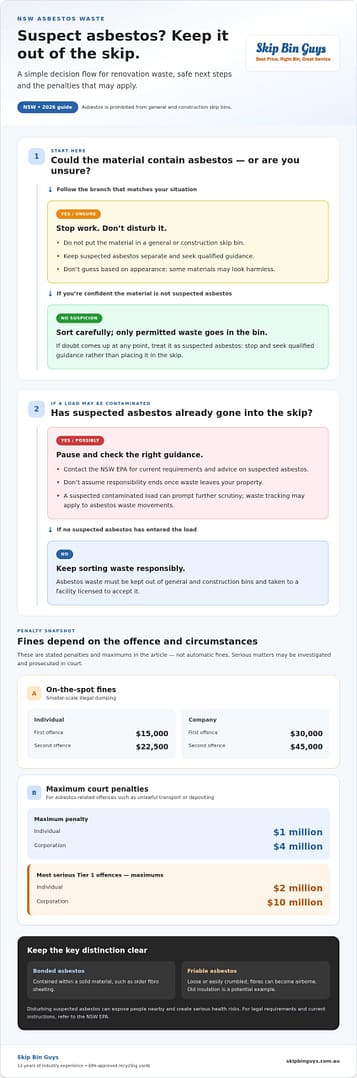
Bonded asbestos is contained within a solid material, such as older fibro sheeting. Friable asbestos is loose or easily crumbled, so fibres can become airborne. Old insulation is a potential example of friable material. Its greater potential to release fibres makes it especially hazardous; handling or disturbing suspected asbestos can expose people nearby and create serious health risks.
Duty of care for Sydney homeowners
Before your skip arrives, sort renovation waste carefully and keep suspected asbestos separate. Don’t assume an item is safe because it looks intact or you didn’t know it contained asbestos. Ignorance shouldn’t be treated as protection from legal consequences; for advice on your obligations, consult the NSW EPA. If you’re unsure about a material, stop work and seek qualified guidance rather than placing it in the bin.
Choosing a reliable skip bin hire Sydney provider supports responsible sorting, but the bin must still contain only permitted waste. Skip Bin Guys has 13 years of experience and uses EPA-approved recycling yards for compliant waste. As your compliance partner, we help make waste sorting clearer, while strictly keeping asbestos out of our bins. For legal requirements or suspected asbestos, refer to the NSW EPA.
Penalties and Fines for Asbestos in Skip Bins
The asbestos in skip bin fine NSW depends on the offence and the circumstances. Under NSW’s stronger penalties, on-the-spot fines for smaller-scale illegal dumping are $15,000 for an individual’s first offence and $22,500 for a second. For companies, the corresponding amounts are $30,000 and $45,000. A penalty notice is not the only possible consequence: serious matters may be investigated and prosecuted in court.
For asbestos-related offences such as unlawful transport or depositing, the maximum court-imposed penalty is $1 million for an individual and $4 million for a corporation; the most serious Tier 1 offences carry maximums of $2 million for an individual and $10 million for a corporation. These are maximums, not automatic fines. The applicable offence and outcome depend on the facts, so seek authoritative guidance from the NSW EPA rather than treating this as legal advice.
On-the-spot fines vs court penalties
A penalty notice may be issued for a smaller-scale illegal-dumping offence. If evidence suggests a more serious breach, the matter may proceed to a fuller investigation and prosecution. Council officers can also enforce local rules about skip-bin placement on a nature strip, but a permit issue is separate from an asbestos offence. Permit conditions vary, so read the relevant Sydney skip bin permits guide; don’t assume a permit is automatically revoked because a load is contaminated.
Waste tracking can help regulators follow asbestos waste movements and identify where a load came from. NSW’s WasteLocate system supports tracking for applicable asbestos waste movements. Record and reporting requirements can depend on the waste and how it is transported, so check current instructions with the EPA NSW. A suspected contaminated load can prompt further scrutiny; don’t assume responsibility ends once waste leaves your property.
Vicarious liability: are you responsible for your tradie?
If a builder puts asbestos in a skip you hired, responsibility isn’t automatically settled by the hire agreement. It depends on the facts and the relevant legal duties. Set expectations in writing before work begins: specify that asbestos is prohibited, require waste to be sorted correctly and keep records of what was agreed. Avoid choosing a quote on price alone if it doesn’t clearly explain how ordinary waste will be handled.
For workplace asbestos handling and removal requirements, consult SafeWork NSW’s asbestos guidance. Skip Bin Guys helps customers sort compliant waste and uses EPA-approved recycling yards. For general or construction waste, our skip bin hire can support a more organised project. For legal requirements, refer to the NSW EPA.
Identifying High-Risk Materials: Identifying Asbestos Before You Hire
Planning a renovation in an older Sydney home? Treat building materials installed before 1990 as potential asbestos until they’ve been assessed. This is a cautious rule of thumb, not proof that a particular surface contains asbestos. NSW estimates that one in three homes built before 1990 contains asbestos, so checking before demolition or disposal is sensible.
Common Sydney renovation materials to watch
Asbestos may be concealed in more than obvious wall sheets. Look out for older fibro cement cladding, corrugated cement roofing, eave linings and textured or “fake brick” cladding. Inside, vinyl floor tiles and the backing beneath old lino can also warrant caution. Older fuse boards may have asbestos-containing backing, and some bathroom waterproofing materials may contain asbestos. Appearance alone can’t confirm what a product is made from.
These materials can turn up in post-war homes across Western Sydney and in renovation work on older Parramatta and Inner West terraces. That’s a reason to check, not a way to identify asbestos by suburb or style. If you can’t establish what a material contains, keep it out of the skip.
Hidden risks and safe testing
Never smash, cut, drill or break a suspicious sheet or tile to make it fit in a bin. Damaging it can release hazardous fibres, particularly if the material is friable. Stop work and avoid disturbing the area. A qualified asbestos professional can assess the material and arrange sampling; samples can be analysed by a laboratory accredited by the National Association of Testing Authorities (NATA) for the relevant test.
Don’t collect a sample yourself unless you’re trained and equipped to do so safely. A test result can help clarify whether a material contains asbestos, but it doesn’t make asbestos suitable for a general or construction skip bin. Identifying it early helps you plan compliant waste handling and avoid contamination complications that can affect a skip load.
Testing, removal and clearance
A clearance certificate is a document issued after an asbestos removal or remediation job has been assessed against applicable clearance requirements. It relates to the assessed work area and conditions, not a blanket guarantee that every part of a property is asbestos-free. The right process depends on the job; refer to SafeWork NSW for current guidance.
Once you’ve separated out materials that may contain asbestos, you can plan ordinary renovation waste more confidently. For guidance on choosing a suitable bin for compliant household rubbish, see our Sydney skip bin hire guide. If you suspect asbestos, don’t load it. For disposal and safety requirements, refer to the NSW EPA and SafeWork NSW.
The Total Financial Impact: Beyond the EPA Fine
An EPA penalty may be only one part of the bill if asbestos contaminates a skip load. The recycling yard may reject or isolate the load rather than process it with ordinary waste. What happens next depends on the circumstances and the relevant disposal requirements, but extra handling, assessment, clean-up and compliant transport can add costs and disrupt a project.
There isn’t a single standard “rejected load” charge to apply to every incident. Any charges may depend on the hire agreement, the extent of contamination and the steps needed to manage the waste safely. A bin or truck that has contacted asbestos may also require specialist assessment or decontamination before it can be used again. Don’t assume a small or hidden fragment will mean a small problem.
Decontamination and disposal costs
Asbestos waste must go to a landfill licensed to accept it. It can’t simply be redirected to an ordinary recycling yard, and transport needs to comply with applicable requirements. These steps can make asbestos disposal more involved than general waste. If contamination is discovered, manual sorting or “picking” through a load isn’t a safe do-it-yourself solution. Disturbing material can expose workers to fibres and complicate clean-up.
For builders, delays can mean disrupted work while the load, bin or affected area is assessed and managed. The length and cost of any interruption vary, so don’t rely on a fixed estimate. Planning a construction skip bin hire project around correctly sorted waste helps reduce avoidable disruption. Skip Bin Guys’ bins are for compliant waste only, never asbestos.
What to do if you suspect contamination
Found something that could be asbestos in the bin? Act cautiously:
- Stop work and keep people away. Don’t touch, move, break or try to bury the material.
- Don’t cover or handle it yourself. Avoid actions that could disturb fibres; seek advice on safe next steps.
- Notify the skip bin provider promptly that you suspect contamination, so the load isn’t treated as ordinary waste.
- Contact the NSW EPA for disposal requirements and consult SafeWork NSW for workplace safety guidance.
Never try to hide suspected asbestos at the bottom of a bin. Concealment won’t make the load safe and may make the situation worse. Careful sorting protects workers, helps prevent contamination and reduces the risk of an asbestos in skip bin fine NSW. For compliant household, construction or hard waste, arrange skip bin hire for your project with Skip Bin Guys.
How Skip Bin Guys Keeps Your Sydney Project Compliant
Good waste management starts before the bin arrives. For 13 years, Skip Bin Guys has helped Sydney customers manage compliant waste responsibly, with clear sorting guidance to reduce the risk of accidental contamination. Asbestos is strictly prohibited in our skip bins, so identifying and separating suspect material before loading is essential.
Choosing the right bin for the waste you’re actually producing can also make a project easier to manage. A bin that’s too small may lead to overfilling or extra disruption, while the right fit helps keep waste contained and the site orderly. Our team can guide you on suitable options for residential, commercial and construction waste. Keep within the bin’s fill limits and follow applicable council rules for placement.
Responsible disposal for compliant waste
Skip Bin Guys uses EPA-approved recycling yards to manage accepted waste responsibly and support safe material recovery. The destination matters: waste should be handled through appropriate channels rather than mixed indiscriminately. This approach helps customers understand where compliant waste goes while keeping hazardous materials such as asbestos out of the recycling stream.
For a business clean-up, renovation or building job, sorting waste at the source makes disposal more straightforward. Our team can offer practical guidance on what belongs in a commercial bin and what must stay out. Explore our commercial skip bin hire in Sydney guide for help planning a business waste set-up.
Book a bin for your project
Whether you’re clearing out a home or organising a worksite, start by separating materials into suitable waste types and estimating the volume you need to dispose of. If you’re unsure about a material, don’t put it in the bin. Suspected asbestos needs to be managed separately, and Skip Bin Guys never collects it. For handling and disposal requirements, refer to the NSW EPA.
That’s how we act as a practical compliance partner: helping you plan for permitted waste, use an appropriate bin and avoid preventable sorting mistakes that could contribute to an asbestos in skip bin fine NSW. Ready to organise compliant waste disposal for your Sydney project? Get a quote from Skip Bin Guys.
Plan your Sydney project with confidence
Asbestos doesn’t belong in a general or construction skip bin. If you suspect a building material contains asbestos, don’t disturb it or mix it with ordinary waste. Identify higher-risk materials before renovation work begins, sort compliant rubbish carefully and refer to the NSW EPA for current disposal requirements.
The asbestos in skip bin fine NSW is only one potential consequence of contamination. A rejected load, extra handling and project delays can add further stress, so careful waste planning protects your health as well as your budget.
For compliant waste, Skip Bin Guys brings 13 years of industry experience, EPA-approved recycling yards and practical guidance for Sydney projects. Same-day delivery is available for compliant waste types. As your waste-sorting partner, we’ll help you plan the right skip bin for your residential, commercial or construction rubbish. Asbestos is never accepted in our bins.
Ready to organise your project’s compliant waste disposal? Book a compliant Sydney skip bin with the experts today. Sort smart, keep your site organised and move ahead with confidence.
Frequently Asked Questions
What is the current fine for asbestos in a skip bin in NSW?
For smaller-scale illegal dumping in NSW, an individual may receive an on-the-spot fine of $15,000 for a first offence or $22,500 for a second. These amounts don’t mean every contaminated skip bin automatically attracts that fine. For asbestos-related offences such as unlawful transport or depositing, the maximum court-imposed penalty for an individual is $1 million. Penalties depend on the alleged offence and circumstances; refer to the NSW EPA for current guidance.
Can I put a small amount of asbestos in a skip if it is wrapped in plastic?
No. Wrapping suspected asbestos in plastic doesn’t make it acceptable in a general or construction skip bin, even if it’s a small amount. Don’t break, move or conceal it in the load. Keep people away from the material and seek advice on safe handling and disposal. Asbestos waste must go to a facility licensed to accept it. Check current requirements with the NSW EPA.
How does the EPA find out if there is asbestos in my skip bin?
The NSW EPA may investigate suspected asbestos waste through inspections, reports and waste movement records. WasteLocate is one tracking tool used for applicable asbestos waste movements, helping regulators follow waste through the disposal chain. A receiving facility may also identify suspect material during waste checks and raise concerns. Tracking and inspection processes depend on the waste and circumstances, so don’t assume a load’s source can’t be traced.
What happens if I accidentally put asbestos in a skip bin?
Stop adding waste and don’t disturb, hide or try to remove the suspected asbestos yourself. Keep people away and promptly tell the skip provider there may be contamination so the load isn’t treated as ordinary waste. Seek handling and disposal guidance from the NSW EPA. If you transported more than 100 kilograms or 10 square metres of household asbestos waste, EPA reporting is required within 24 hours of delivery.
Do I need a special permit for a skip bin if I am removing old fibro?
A council permit for placing a skip bin on public land is separate from asbestos removal and disposal requirements. Rules for bin placement depend on the local council. For removal, a licensed asbestos removalist is required for any amount of friable asbestos and more than 10 square metres of non-friable asbestos; SafeWork NSW recommends a licensed professional for any amount. Seek current guidance from SafeWork NSW and the NSW EPA before work begins.
Who is legally responsible for a contaminated skip bin: the owner or the hirer?
There isn’t one automatic answer: responsibility depends on who handled, transported or disposed of the waste and the circumstances of the incident. Hiring the bin doesn’t by itself settle legal responsibility, nor does blaming a tradie. Set waste-sorting expectations in writing, keep relevant records and act promptly if you suspect contamination. For advice about legal duties or an investigation, contact the NSW EPA.
How much does it cost to decontaminate a skip bin in Sydney?
There’s no single verified Sydney-wide decontamination price to quote. Costs can vary with the type and extent of contamination, the assessment and clean-up needed, and compliant transport and disposal arrangements. A receiving facility may reject or isolate a contaminated load, creating additional handling and project delays. Don’t try to sort or clean the bin yourself. Contact the skip provider about the incident and seek disposal guidance from the NSW EPA.
Can I dispose of asbestos in my red council bin instead?
No. Don’t put asbestos in a red-lid council bin, a recycling bin or a general skip. Household bins aren’t a suitable disposal route for asbestos waste, which must go to a landfill licensed to accept it. Keep suspected material undisturbed and seek safe disposal instructions from the NSW EPA. If you’re unsure whether an item contains asbestos, don’t place it in any household or skip bin.