
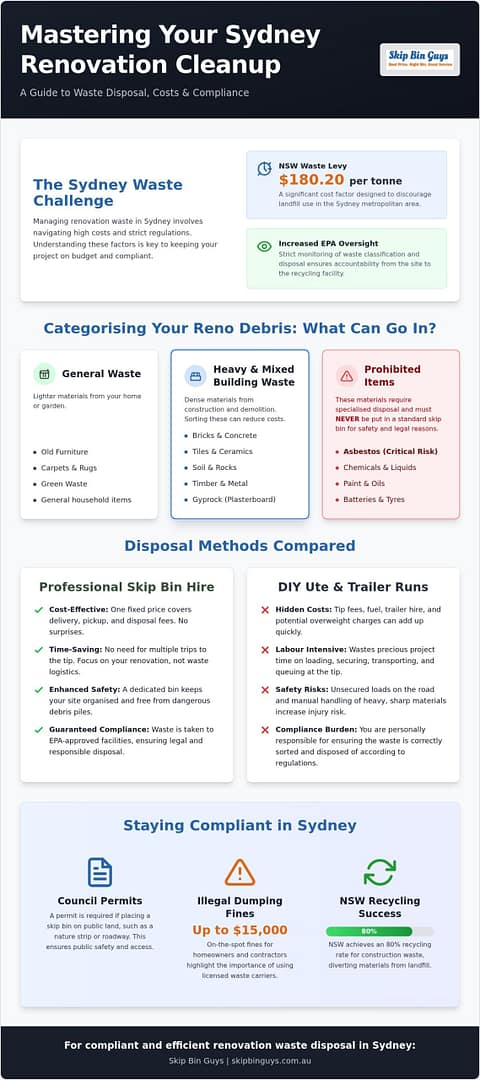
What if the most expensive part of your home makeover isn’t the designer tiles or the new cabinetry, but the pile of debris sitting on your nature strip? It’s a common realisation for many homeowners who find that renovation waste disposal Sydney can quickly become a logistical headache if you aren’t prepared. Between the rising NSW waste levy, which hit $180.20 per tonne this year, and the maze of local council permits, it’s easy to feel overwhelmed by the cleanup process.
We understand that staring at a mountain of mixed timber, concrete, and old plasterboard is the last thing you want to do after a long day of building. You’re likely worried about hidden overweight fees or whether you’ve accidentally mixed in something that doesn’t belong. This guide will help you master your site cleanup by showing you how to sort waste like a pro, secure the right permits, and choose a skip bin partner that actually understands Sydney’s unique logistics. You’ll learn exactly how to stay compliant with the latest 2026 EPA rules while keeping your project on budget and on schedule.
Key Takeaways
- Understand the critical difference between heavy and general waste categories to avoid surprise fees and streamline your on-site sorting.
- Navigate Sydney council permit requirements with confidence to ensure your bin placement is legal and stress-free.
- Master the art of renovation waste disposal Sydney by learning how to manage mixed building materials like timber, tiles, and gyprock efficiently.
- Discover how using EPA-approved recycling facilities helps protect the environment while staying compliant with strict NSW regulations.
- Compare disposal methods to see why professional skip bin hire is often more cost-effective and convenient than multiple DIY tip runs.
Understanding Renovation Waste Disposal in Sydney
What exactly is renovation waste? It is a specific category of demolition waste that combines inert materials like concrete and bricks with general debris such as old cabinetry, flooring, and gyprock. In our harbour city, managing this mix isn’t just about keeping the site tidy; it’s a legal and financial strategy. Every piece of debris you create needs a compliant home.
Why is renovation waste disposal Sydney so different from other Australian cities? It mostly comes down to the NSW Metropolitan Levy. As of July 1, 2026, this levy is set at $180.20 per tonne for the Sydney metropolitan area. This high cost is a deliberate move by the government to discourage landfill use and push materials toward recycling centres. The good news is that it works. NSW recently achieved an 80% recycling rate for construction and demolition waste, proving that your old bathroom or kitchen doesn’t have to end up in a hole in the ground.
The 2026 Waste Landscape in NSW
The EPA has significantly increased its oversight this year. They are focusing heavily on how waste is classified and documented from the moment it leaves your driveway. If you’re a homeowner, don’t assume your builder has all the accountability. While builders often handle the physical removal, the property owner can still be held responsible for where that waste eventually ends up. Illegal dumping now attracts on-the-spot fines of up to $15,000. Partnering with a licensed waste carrier who uses EPA-approved recycling yards is the only way to ensure you aren’t left liable for a contractor’s shortcuts.
Why a Dedicated Skip is Essential for Renovations
Have you ever tried to put a broken tile or a piece of concrete in your council red-lid bin? It’s a recipe for trouble. Most Sydney councils strictly ban building materials from residential kerbside collection. Even if you could fit the debris, the sheer weight would likely damage the bin or result in a “failed collection” notice from the driver.
A dedicated skip bin provides a central, safe point for all your project’s mess. This keeps your site clear of sharp nails, jagged timber, and trip hazards that can cause serious injury. It also saves you from the “ute and trailer” nightmare. Instead of spending your precious Saturday morning queuing at the Artarmon or Strathfield tips, you can focus on the actual renovation. We’ve seen many DIYers lose hours in traffic only to find that tip fees are higher than they expected. A skip bin simplifies the math and the manual labour, keeping your project moving forward.
Categorising Your Reno Debris: What You Can and Can’t Bin
Understanding exactly what is going into your bin is the most effective way to manage your costs. In the world of renovation waste disposal Sydney, we generally split debris into two main camps: general waste and heavy waste. General waste covers lighter items like old furniture, carpets, and green waste. Heavy waste is where the real weight lies, including bricks, concrete, tiles, and soil. Mixing these two can lead to unexpected costs, as most facilities charge based on the heaviest material in the load.
Finding competitive skip bin hire prices Sydney depends heavily on how well you sort these materials before the truck arrives. If you have a massive amount of concrete from a driveway tear-out, keep it separate from your bathroom tiles. Pure loads of concrete or brick are much easier to recycle, and we can often pass those savings on to you. If everything is tossed in together, it becomes “mixed building waste,” which requires more intensive sorting at the recycling yard.
The “Mixed Building” Category Explained
For a typical Sydney kitchen or bathroom renovation, you will likely produce a mix of timber, metal, gyprock, and ceramics. This is what we call mixed building waste. In 2026, the handling of gyprock (plasterboard) has become even more specialised. Because it can produce foul-smelling gases when mixed with wet organic waste in a landfill, EPA-approved yards now require it to be handled with care. Sorting your plasterboard scraps into a dedicated pile can make the whole process smoother. If you aren’t sure how to categorise your mess, our team is always happy to provide a quick waste assessment to keep your project on track.
Hazardous Waste: The Deal-Breakers
Safety is our priority, and that means being strict about what stays out of the bin. Asbestos is the most critical deal-breaker. With many Sydney homes built before 1990, the risk of encountering bonded asbestos in “wet areas” or eaves is high. You must never put asbestos in a standard skip. Following the NSW EPA renovation waste rules is mandatory; homeowners can only remove up to 10 square metres of non-friable asbestos themselves before a licensed professional must step in. Other prohibited items include:
- Paints, solvents, and chemicals
- Gas bottles and fire extinguishers
- Car batteries and lithium-ion batteries
- Liquid waste of any kind
For these items, Sydney residents should look for “Community Recycling Centres” or “Chemical CleanOut” events hosted by local councils. These specialist facilities are designed to handle toxins that regular recycling yards cannot process. Keeping these out of your skip ensures your waste can be recycled safely and legally.
Comparing Disposal Methods: Why Skip Bins Win for Sydney Renos
When you’re knee-deep in a home project, the most efficient way to handle renovation waste disposal Sydney is often the first thing people try to shortcut. It’s tempting to think that a few trips to the tip or a council pickup will save a few dollars. But when you look at the total cost of effort, these alternatives often fall short of the mark. Choosing the wrong method can turn a simple cleanup into a month-long saga of logistics and heavy lifting.
The Limitations of Council Cleanups
Most Sydney councils are quite strict about what they’ll collect from your kerb. If your pile contains bricks, sand, cement, or large amounts of timber, it will likely be left behind. Council hard waste services are designed for old mattresses and broken fridges, not a bathroom demolition. Beyond the material restrictions, you’re often looking at a three-week wait for a booking. Leaving a non-compliant pile on the nature strip doesn’t just annoy the neighbours; it can lead to on-the-spot fines of up to $15,000 if the materials are deemed commercial or hazardous.
The Hidden Costs of DIY Tip Trips
The “ute and trailer” method is a classic Aussie approach, but is it actually cost-effective? In 2026, every resident pays the Metropolitan Levy at the weighbridge, currently $180.20 per tonne. When you add up trailer hire, fuel, and the hours spent sitting in Sydney traffic, the “free” tip run starts to look very expensive. There’s also the physical toll to consider. Loading a trailer at home and then hand-unloading it at a transfer station means you’re handling every heavy piece of debris twice. This is why residential skip bin hire Sydney provides much better value. You load it once, and we handle the logistics, the weighbridge fees, and the recycling yards on your behalf.
Evaluating Rubbish Removal Services
Hands-on rubbish removal is another option where a team comes to load the waste for you. While it saves your back, you’re paying a premium for that labour on top of the disposal fees. For a medium-to-large renovation, this cost can quickly spiral. A skip bin gives you a steady, reliable place to toss debris as you go. This keeps your site organised without the ticking clock of an hourly labour rate. It’s about finding that sweet spot between your budget and your sanity, ensuring your renovation stays a dream rather than a disposal nightmare.
Navigating Sydney Council Rules and Site Logistics
Sydney is famous for its charming terrace houses and leafy suburbs, but for renovation waste disposal Sydney, those narrow Inner West lanes or CBD side streets can be a logistical challenge. Before you book your bin, you need to think about where it will actually sit. If you have a driveway or a front yard, you’re in the clear. However, if you’re planning on using the nature strip or a public parking spot, things get a bit more official. Our city’s unique layout means that “one size fits all” doesn’t apply to bin placement.
Council Permits and the Nature Strip
Do you need a skip bin permit Sydney? The answer depends entirely on your local government area. For example, the City of Sydney and Inner West Council have very different rules regarding street placement compared to the Northern Beaches or Parramatta. Generally, if the bin touches public land, a permit is mandatory. In many cases, we can help organise this as part of our service, but some councils require the homeowner to apply directly. Don’t forget safety; bins placed on the road often require reflectors or flashing lights to stay compliant with local laws. If you’re unsure about your specific suburb’s quirks, chat with our local experts to get the right advice before your bin arrives.
We also need to consider physical access. Low-hanging overhead wires in suburbs like Paddington or tight corners in Balmain can prevent a standard truck from dropping a bin safely. Always mention these obstacles when you book. It’s much better to plan for a smaller truck or a specific drop-off point than to have a delivery fail on the day because of a low branch or a power line.
Packing Your Bin Like a Pro
Once your bin is delivered, don’t just start throwing things in randomly. Use the “Tetris Method” to maximise every cubic metre of space. Start by placing flat, heavy items like old timber flooring or gyprock sheets on the bottom. This creates a solid base and prevents large air pockets that waste space. Next, fill the gaps with smaller debris like broken tiles or garden waste.
It’s tempting to keep stacking until the pile reaches for the sky, but “overfilling” is a major safety hazard and a legal no-go. NSW road laws are very clear: a load must be level with the rim of the bin. If debris is poking out the top, our drivers legally cannot transport it because it risks spilling onto the road. Packing efficiently isn’t just about getting better value for your money; it’s about making sure your waste actually makes it to the recycling yard without a hitch.
Streamlining Your Project with Skip Bin Guys
Managing renovation waste disposal Sydney doesn’t have to be the most stressful part of your home improvement journey. With over 13 years of local experience, we’ve seen every type of project, from small bathroom refreshes in Parramatta to major structural overhauls in the CBD. Our team operates with a deep understanding of Sydney’s unique logistics, ensuring that your skip bin is more than just a box on the street; it’s a tool for a smoother, cleaner site.
Sustainability isn’t just a buzzword for us; it’s a core part of how we do business. We exclusively use EPA-approved recycling yards to process your debris. By choosing us, you’re ensuring that your old materials are sorted and repurposed wherever possible, contributing to the city’s goal of reducing landfill pressure. For professional renovators and project managers, we provide specialised construction skip bin hire Sydney that meets the rigorous demands of a busy building site.
We know that timing is everything when you have trades on-site waiting for space. That’s why we offer same-day delivery for orders placed before 10:30 am. If you realise mid-morning that you’ve underestimated your waste, we can often have a fresh bin at your doorstep before the sun goes down. It’s this level of responsiveness that keeps Sydney projects moving forward without unnecessary delays.
Why Sydney Homeowners Trust Us
What makes us different? It’s the friendly, local support we provide at every step. We understand that you might be worried about narrow street access or specific council rules, and we’re here to guide you through those challenges. Our satisfaction guarantee means we don’t just drop a bin and disappear; we ensure it arrives on time and is collected promptly once you’re finished. Plus, we believe in transparent pricing. You won’t find any hidden “Sydney traffic” surcharges or surprise fees when the bill arrives. What we quote is what you pay.
Ready to Clear the Clutter?
Getting your site back in order is easier than you think. You can book your bin in under 3 minutes by giving us a call or using our online system. To make the process even faster, have a few details ready: the type of waste you’re disposing of (like general or heavy waste) and exactly where you want the bin placed. Whether it’s a tight driveway or a specific spot on the nature strip, we’ll make it happen. Get a quote from Skip Bin Guys today and let us take the weight off your shoulders.
Ready to Clear the Way for Your Dream Home?
Transforming your home is an exciting journey, but it shouldn’t be stalled by a growing pile of debris. By categorising your materials and understanding local council permit rules, you can keep your project on budget and legally compliant. Remember that sorting heavy waste from general debris isn’t just good for the environment; it’s a smart way to manage the rising costs of disposal in 2026.
With over 13 years of local expertise, we make renovation waste disposal Sydney look easy. We handle the heavy lifting and ensure your waste reaches EPA-approved recycling yards to maximise material recovery. If you’re ready to clear the way for your new kitchen or bathroom, we’re here to help. Order before 10:30 am to enjoy same-day delivery and keep your trades moving. Book your Sydney renovation skip bin now with Skip Bin Guys and take the first step toward a clutter-free site. We’re looking forward to being your partner in building something great.
Frequently Asked Questions
Do I need a permit for a skip bin in Sydney?
You only need a permit if the bin sits on public land, such as the road or a nature strip. If you can place the skip entirely within your own driveway or front yard, no council approval is required. Every Sydney council has its own specific set of rules and fees for street placement. We recommend checking with your local authority or asking our team for advice on your specific suburb’s requirements.
What happens if I put asbestos in a skip bin?
Asbestos is strictly prohibited in our bins. If we find asbestos in a load, the entire bin is treated as hazardous waste, leading to heavy decontamination fees and potential legal penalties. For Sydney homes built before 1990, always test suspicious materials first. Homeowners can only remove up to 10 square metres of non-friable asbestos; anything else requires a licensed professional and specialised disposal at an EPA-approved facility.
Can I put old bathroom tiles and concrete in the same bin?
You can definitely mix these materials in a heavy waste bin. However, for efficient renovation waste disposal Sydney, keeping tiles and concrete separate from general debris like timber and plasterboard can be more cost-effective. Pure loads of brick or concrete are easier for us to process at recycling yards. If you have a large volume of masonry, ask us about a dedicated bin to help streamline your project costs.
How long can I keep a skip bin for my renovation?
Our standard hire period is typically seven days, which covers most small-to-medium home projects. We understand that renovations can be unpredictable, so we offer flexible hire durations to suit your specific timeline. If you finish early or need an extension, just give us a call. We aim to keep your site organised and safe without the stress of a rigid, immovable collection deadline.
What is the best skip bin size for a kitchen renovation?
A 4m³ or 6m³ bin is usually the sweet spot for a standard kitchen renovation. While it might look like a few cabinets, once you add old flooring, gyprock scraps, and packing materials, the volume adds up quickly. It’s often better to choose a slightly larger bin than you think you need. This prevents overfilling, which is a safety hazard that prevents our drivers from legally transporting the load.
Do you offer same-day skip bin delivery in Parramatta?
We certainly do. We provide same-day delivery to Parramatta and surrounding Sydney suburbs for all orders confirmed before our 10:30 am cut-off. Our team understands that renovation schedules can change in an instant, so we work hard to get your skip on-site as quickly as possible. This responsive service keeps your trades moving and ensures you aren’t left tripping over piles of building debris.
What items are strictly prohibited in a renovation skip?
You must never put hazardous or liquid materials in a skip. This includes asbestos, paints, solvents, chemicals, car batteries, and gas cylinders. These items pose a serious risk to our staff and the environment. Sydney residents should take these materials to a Community Recycling Centre or a Chemical CleanOut event. Keeping these out of your bin ensures we can process your renovation waste safely at EPA-approved recycling facilities.
How much does renovation waste disposal cost in Sydney?
Pricing depends on the size of the bin and the type of materials you’re disposing of. The NSW Metropolitan Levy, currently $180.20 per tonne in 2026, is a major factor in disposal costs across Sydney. We focus on transparent pricing and maximising material recovery to keep your fees as low as possible. By sorting your waste correctly, you can avoid extra charges and ensure your renovation stays within your budget.