
Did you know that mismanaging your site waste could lead to penalties reaching as high as $500,000 under the latest NSW environmental regulations? It’s incredibly frustrating when a simple backyard renovation or site clear-out turns into a legal and financial headache because of confusing soil disposal Sydney regulations. You likely want the excess dirt gone yesterday, but the complexity of EPA classifications like VENM and ENM can make the whole process feel like a total minefield.
This guide will show you how to navigate these rules safely, helping you choose the right skip bin size for heavy loads while ensuring every gram of waste is recycled at an EPA-approved facility. We’ll break down the 2026 disposal requirements, explain how to avoid heavy contamination fees, and give you a clear plan to reclaim your space without the risk of a nasty surprise from the authorities. By the end, you’ll have the confidence to handle your waste responsibly, legally, and affordably. Let’s get your project back on track with a plan that works.
Key Takeaways
- Distinguish between VENM and ENM classifications to ensure your waste meets strict EPA standards and avoids heavy contamination fees.
- Navigate soil disposal Sydney requirements safely to protect your property from significant council fines and environmental penalties.
- Master the “Weight Trap” by learning how to calculate soil density so you choose the most efficient skip bin size for heavy loads.
- Determine exactly when your project requires a council permit for nature strip placement versus keeping the bin on private property.
- Ensure your excavated earth is handled responsibly at EPA-approved recycling centres while taking advantage of same-day delivery for urgent projects.
Navigating Soil Disposal in Sydney: Why It’s More Than Just Dirt
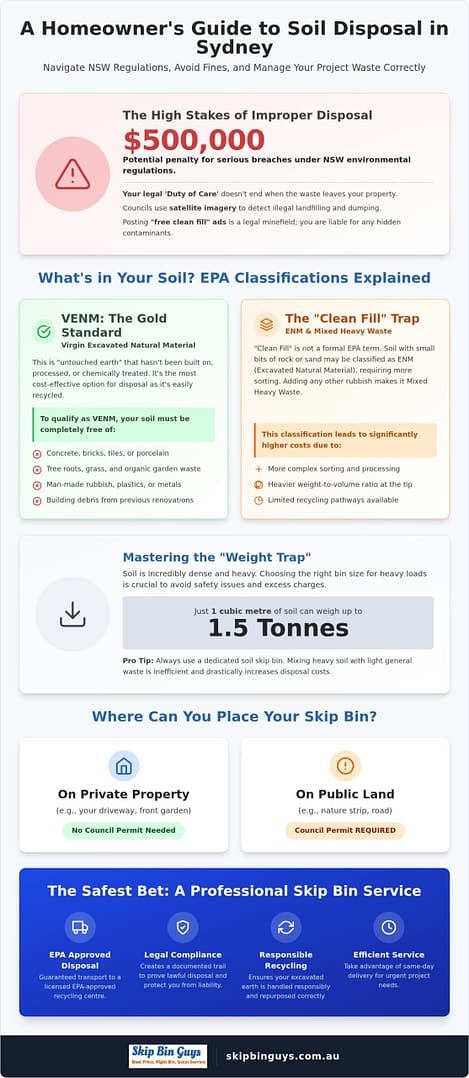
Think of soil disposal Sydney as a controlled logistical operation rather than just a weekend chore. In the eyes of the law, the moment you dig up earth to make room for a new pool, deck, or extension, that material is classified as waste. This means it must be transported to a facility specifically licensed by the NSW EPA to receive it. It isn’t just about getting the pile off your driveway; it’s about ensuring the earth is handled in a way that protects our local environment.
It’s often tempting to post a “free clean fill” ad on social media to save a few dollars. While this seems like a win-win, it’s actually a legal minefield. You cannot easily verify the quality of the soil without professional testing. If that dirt contains hidden contaminants like lead or glass, you are the one on the hook. If the person who collects it dumps it in a local park or an unpermitted site, the authorities can often trace that waste back to your property.
The Legal Risks of Improper Disposal
Every waste producer in NSW has a legal “Duty of Care” that doesn’t end when the truck pulls away. You are responsible for your waste until it reaches a lawful destination. Many Sydney residents are surprised to learn that local councils now use advanced satellite imagery to monitor illegal land filling. If they notice a change in land height that hasn’t been approved, they will investigate. For serious breaches of environmental regulations, fines can reach up to $500,000 for businesses. Even minor accidental dumping can result in heavy council fines that far outweigh the cost of proper disposal.
Why a Dedicated Skip Bin is the Safest Bet
Using a professional skip bin service is the only way to guarantee your project stays compliant. At Skip Bin Guys, we bring 13 years of industry experience to every job, ensuring your soil disposal Sydney needs are met with total transparency. When you hire a dedicated bin, your waste is taken directly to an EPA-approved recycling yard where it is processed correctly. This creates a documented trail of where your soil ended up, shielding you from potential legal trouble. It also offers the ultimate convenience of a central collection point on your driveway or nature strip, keeping your site organised and safe while you work.
Understanding Soil Classifications: VENM, ENM, and Clean Fill
You might hear different terms thrown around when researching soil disposal Sydney, but getting the terminology right is the difference between a smooth project and a massive bill. The NSW EPA uses specific categories to decide where dirt can go and how much it costs to process. If you’re tackling a residential project, you’ll likely deal with VENM or ENM. Understanding these isn’t just for the experts; it’s the best way to keep your costs down.
What is VENM and Why Does it Matter?
VENM stands for Virgin Excavated Natural Material. Think of this as “untouched earth” that hasn’t been built on, manufactured, or chemically treated. It’s the gold standard for recycling because it’s easy to repurpose for new landscaping or infrastructure projects. Because it’s so easy to process, it’s also the most cost-effective option for your skip bin hire. To qualify as VENM, your load must be completely natural material that hasn’t been processed or contaminated in any way.
Before you start digging, check that your soil is free of the following:
- Concrete, bricks, or porcelain tiles
- Tree roots, large amounts of grass, or organic garden waste
- Man-made rubbish, plastics, or metals
- Building debris from previous renovations
The “Clean Fill” Trap and Mixed Waste
Many people use the term “clean fill” when chatting with neighbours or posting online, but it’s a bit of a trap. In the professional waste industry, “clean fill” isn’t a formal EPA classification. What you might call “clean” could still contain small bits of rock, sand, or old building debris. This is often classified as ENM (Excavated Natural Material). While ENM is still recyclable, it requires more rigorous testing and sorting than VENM, which can affect disposal paths.
It’s also vital to avoid mixing soil with general rubbish. Soil is incredibly heavy; putting just a few planks of wood or an old chair into a soil bin turns the entire load into “Mixed Heavy Waste.” This category is much more expensive to tip because of the weight-to-volume ratio. If you aren’t sure which category your dirt fits into, the team at Skip Bin Guys can help you identify the right bin for your specific site conditions.
Dealing with Contaminated or “Dirty” Soil
Safety is the priority when digging in Sydney’s older suburbs. If you notice a strong chemical odour, an oily sheen on the surface, or unusual discolouration like blue or bright green patches, stop digging immediately. These are classic signs of contamination. Asbestos-contaminated soil is another major risk in areas where fibro debris might have been buried decades ago. If a skip bin is rejected at the tip because of hidden contaminants, the costs to remediate the load are astronomical. Always check your soil quality before you start loading to keep your project moving safely.
Choosing the Right Skip Bin for Soil and Dirt
One of the most common mistakes in soil disposal Sydney is underestimating just how heavy earth really is. While a pile of dirt might look manageable, it’s incredibly dense. On average, a single cubic metre of soil weighs approximately 1.5 tonnes. If that soil is damp or contains heavy clay, the weight climbs even higher. This “Weight Trap” is exactly why you’ll rarely see skip bin companies offering 6m³ or 10m³ bins for soil only; the physical weight would simply be too much for a standard truck to lift safely.
Most professional services limit “dirt only” bins to 2m³ or 4m³ sizes to protect both the equipment and your property. Attempting to fill a massive bin with soil is a recipe for disaster. If a bin is overloaded beyond the rim or exceeds the truck’s lifting capacity, the driver legally cannot transport it. This leaves you with a heavy, immobile bin on your property and a wasted delivery fee. To see how these smaller bins compare to larger options, check out our guide on skip bin sizes for visual comparisons.
Standard Sizes for Heavy Waste
For most backyard renovations, the 2 cubic metre bin is the “Goldilocks” size. It’s easy to load, fits into tight Sydney driveways, and stays well within the safety limits of the skip truck’s hydraulic arms. When you move up to a 4m³ bin, you’re pushing roughly 6 tonnes of weight. This is the upper limit for many residential skip trucks. If you’re unsure how much you’ve actually dug up, use this simple formula: Length x Width x Depth x 1.3. That extra 0.3 accounts for the “fluff factor,” as soil expands once it’s disturbed and no longer compacted in the ground.
The “Dirt Only” Rule
Keeping your load “pure” is the secret to a stress-free experience. If you’re paying for a soil bin, it must contain only soil. Tossing in a single piece of treated timber, a plastic bag, or a broken garden chair turns that affordable load into an expensive “Mixed Heavy Waste” category. This happens because the recycling facility can no longer process the load as clean earth. It has to be manually sorted, which adds significant cost to your disposal.
Managing your bin is also about managing your neighbours. In many Sydney suburbs, an open skip bin is seen as an invitation for others to get rid of their unwanted junk. This can ruin your load and leave you with the bill. We always recommend covering your bin with a heavy-duty tarp when you aren’t using it. This doesn’t just discourage illegal dumping; it also prevents rainwater from soaking into the soil. Remember, wet soil is much heavier than dry soil, and you don’t want to pay for the weight of a Sydney rainstorm.
Council Permits and Nature Strips: What Sydney Residents Need to Know
Deciding where to place your skip is just as vital as choosing the right size for soil disposal Sydney. If you can fit the bin entirely within your property boundary, such as on a driveway or in a front yard, you generally won’t need to worry about council paperwork. However, many Sydney blocks are tight. If the only viable spot is the nature strip or the street, you’ll need to secure a council permit before the truck arrives. Each local government area handles this differently. The rules in Parramatta might differ significantly from those in the Hills Shire or Penrith.
Ignoring these permits is a risky move. Rangers across Greater Sydney are active in 2026, and an unpermitted bin can lead to immediate fines that far exceed the cost of the permit itself. To find the specific requirements for your local area, you can refer to our Sydney Skip Bin Permits guide, which includes links to major council portals across the metropolitan area.
Placing Your Bin Safely
Safety is paramount when dealing with the extreme weight of excavated earth. A 4 cubic metre bin filled with dirt can weigh over 6 tonnes. This amount of pressure can easily crack old terracotta sewer pipes or damage underground utility lines buried beneath your nature strip. Always check for the location of your water meter and avoid placing the bin directly over any service pits. If you are placing the bin on the road, it must be positioned so it doesn’t obstruct traffic or block the sightlines of neighbours pulling out of their driveways. Keeping the peace with your neighbours is often as simple as letting them know when the bin is arriving and ensuring it doesn’t spill over onto their section of the strip.
How to Organise a Permit
Applying for a permit in 2026 is usually a straightforward online process. Most councils require at least two to five business days to process an application, so don’t leave it until the morning of your project. You’ll typically need to provide the bin dimensions, the exact placement location, and the duration of the hire. At Skip Bin Guys, we’ve spent 13 years navigating these local regulations. We can often assist with the permit application process or provide the necessary public liability insurance certificates that councils require. If you’re ready to get your project moving without the stress of council red tape, contact us today for expert advice on your specific site setup.
Efficient Soil Removal with Skip Bin Guys
Managing a project in a busy city requires a partner who understands the local pace and the strict regulatory environment. With over 13 years of industry experience, Skip Bin Guys has become a trusted name for soil disposal Sydney residents rely on. We don’t just drop off a bin and disappear; we act as your local guide to ensure your site is cleared efficiently while meeting every legal requirement. If your project is urgent, our same-day delivery guarantee for orders placed before 10:30 am means you can start digging and have that pile gone by sunset.
Choosing us also means choosing environmental responsibility. We are passionate about sustainability, which is why 100% of the soil we collect is transported to EPA-approved recycling yards. This ensures that your excavated earth doesn’t just end up in a landfill. Instead, it is carefully screened and processed to become high-quality garden mix or fill for future infrastructure projects. It’s a circular approach that gives you total peace of mind that your waste is being handled with care.
Our Process from Delivery to Disposal
How do we handle those notoriously tight Sydney driveways? Our experienced drivers are experts at manoeuvring our trucks into challenging spaces, ensuring your bin is placed exactly where you need it for easy loading. Once you’ve filled the skip, we whisk it away to a specialised sorting centre. Here, any small bits of debris are removed, and the soil is tested to ensure it meets recycling standards. Throughout the process, our friendly local support team is just a phone call away to answer questions, providing a level of service that larger, impersonal corporations simply can’t match.
Ready to Clear Your Site?
Before you pick up the phone or book online, run through this quick final checklist to ensure your soil removal goes off without a hitch:
- Access: Is there a clear, overhead-unobstructed path for a heavy truck to enter and exit?
- Volume: Have you accounted for the “fluff factor” when choosing between a 2m³ or 4m³ bin?
- Soil Type: Is your load pure, untouched earth (VENM), or does it contain bits of rock and sand (ENM)?
If you’re ready to reclaim your backyard or clear your construction site, you can get a quick quote through our website or by chatting with our team. For more tips on managing home projects, explore our Residential Skip Bin Hire Sydney guide. Book your soil bin today and let’s get that dirt moving!
Start Your Sydney Soil Project with Confidence
Managing a backyard renovation or site clear-out doesn’t have to be a source of stress. By understanding the difference between VENM and ENM and staying on top of council permit requirements, you’ve already done the hard work to ensure your project remains legal and cost-effective. Remember to account for the massive weight of earth when choosing your bin size; keeping your load pure and below the rim is the best way to avoid transport delays. With the right plan in place, soil disposal Sydney becomes a smooth, predictable part of your build.
Skip Bin Guys is here to make the process even easier. With over 13 years of local experience, we provide the expert guidance and reliable service you need to get the job done right. Our same-day delivery for orders placed before 10:30 am keeps your project moving at pace, while our use of EPA-approved recycling yards ensures your waste is handled with total environmental care. Ready to see that pile of dirt disappear? Get a Quote for Soil Disposal in Sydney Now and let’s get your site cleared by tomorrow. We’re ready to help you transform your space today.
Frequently Asked Questions
Can I put dirt and grass together in a soil skip bin?
No, you cannot mix dirt and grass in a dedicated soil skip bin. While a few stray blades are usually fine, significant amounts of turf or garden organic matter turn the load into “Mixed Waste.” This happens because organic material complicates the recycling process at EPA-approved yards. If you have large amounts of turf, it’s better to hire a separate green waste bin or a mixed heavy waste skip to avoid extra sorting fees at the tipping facility.
How much soil can I put in a 4m³ skip bin without it being too heavy?
You can fill a 4m³ skip bin to the top rim, but never beyond it. Since 1 cubic metre of soil weighs approximately 1.5 tonnes, a full 4m³ bin will weigh about 6 tonnes. This is the maximum lifting capacity for most residential skip trucks in Sydney. If you fill it higher, the truck won’t be able to lift it safely, and you’ll be required to remove the excess before the driver can take it away.
Do I need to test my soil for contamination before hiring a bin?
For most standard residential backyard projects, formal testing isn’t required unless you suspect contamination. However, you should always check for unusual odours, discolouration, or oily sheens. If your property has a history of industrial use or you find fibro debris, testing becomes essential to avoid illegal dumping of hazardous materials. When in doubt, it’s always safer to consult with a professional before you start your soil disposal Sydney project to ensure everything stays above board.
What is the difference between clean fill and VENM in Sydney?
VENM (Virgin Excavated Natural Material) is a formal EPA classification for untouched, natural earth like clay and rock. “Clean fill” is a more casual term often used by homeowners, but it doesn’t have a strict legal definition. What one person calls clean fill might actually contain bits of concrete or brick, which would technically classify it as ENM. Using the correct EPA terms ensures your waste is accepted at the right recycling facility without unexpected price hikes.
Can I place a heavy soil bin on my driveway without it cracking?
Placing a heavy soil bin on a driveway carries a risk of cracking, especially with older concrete or decorative pavers. A full 4m³ bin can exert 6 tonnes of pressure on a small area. We recommend placing thick timber planks down first to distribute the weight more evenly. If your driveway is particularly thin or already showing signs of wear, placing the bin on the road with a council permit is often the much safer alternative.
What happens if someone puts rubbish in my soil-only skip bin?
If non-soil rubbish ends up in your bin, the entire load is reclassified as “Mixed Heavy Waste.” This results in higher tipping fees because the facility has to manually separate the contaminants from the clean soil. To prevent this, we suggest covering your skip with a heavy-duty tarp whenever you aren’t actively loading it. This simple step discourages neighbours from using your bin as a public dump and keeps your disposal costs as low as possible.
Does Skip Bin Guys offer same-day delivery for soil bins in Parramatta?
Yes, we provide same-day delivery for soil bins across Parramatta and the wider Sydney metropolitan area. To secure your bin for the same day, simply place your order before 10:30 am. This service is perfect for those unexpected weekend projects or when you’ve dug up more earth than you originally planned. Our local team understands the Western Sydney landscape well, ensuring your delivery is handled with professional care and efficiency every single time.
How long can I keep the skip bin on my property for a landscaping job?
Our standard hire period is typically seven days, which is usually plenty of time for most residential landscaping projects. If you find your project is taking a little longer than expected, just give our friendly team a call to organise an extension. We aim to be as flexible as possible to help you get the job done without feeling rushed. Just remember that if the bin is on the street, your council permit must cover the entire duration.