
Did you know that placing a skip bin just half a metre onto the nature strip without the right paperwork could cost your business more than the entire week’s hire? It’s incredibly frustrating when you’re trying to coordinate a tight schedule for a new retail space, only to have a council ranger threaten a heavy fine or halt your progress because of a simple placement error. We understand that securing reliable skip bin hire for shop fitouts Sydney involves more than just finding a bin; it’s about managing the specific red tape that varies between the City of Sydney, Parramatta, and the Northern Beaches.
This guide will help you master the 2026 local regulations and placement rules to ensure your waste management remains fine-free and fully compliant with Sydney council bylaws. You’ll gain a clear checklist for legal skip placement, an understanding of when a permit is strictly necessary, and the confidence that your project won’t be derailed by unexpected costs. We’ve broken down everything from the latest EPA levy requirements to the specific permit timelines required by local councils, so you can focus on the build while we help you handle the compliance.
Key Takeaways
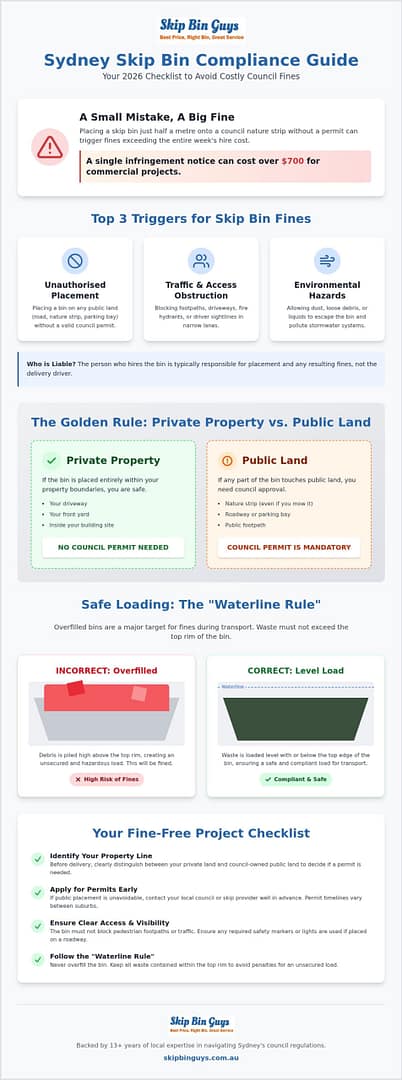
- Spot the common triggers that Sydney council rangers look for when issuing fines for unauthorised placement or traffic obstructions.
- Clarify exactly where private property ends and public land begins to avoid paying for unnecessary permits on your own driveway.
- Ensure your skip bin hire for shop fitouts Sydney meets strict safety standards, including visibility markers and maintaining clear pedestrian access on footpaths.
- Learn the “Waterline Rule” for loading to prevent heavy penalties for overfilled bins or unsecured loads during transport across the city.
- Benefit from 13 years of local expertise to navigate the complex permit systems of different Sydney suburbs with total confidence.
Why Sydney Councils Issue Skip Bin Fines (and How to Spot the Triggers)
Ever wonder how council rangers spot a skip bin that shouldn’t be there? In Sydney, local rangers are highly active, especially in high-density areas like the CBD, Surry Hills, or Parramatta. They aren’t just checking for overstayed parking; they’re tasked with ensuring the safety and cleanliness of public thoroughfares. When you arrange skip bin hire for shop fitouts Sydney, you’re essentially placing a large industrial object in a public space. If that bin doesn’t have the right permit or blocks a clear path for pedestrians, it becomes an immediate target for an infringement notice.
Most fines fall into three distinct categories that are easy to avoid if you know what to look for:
- Unauthorised placement: Putting a bin on a road, parking bay, or nature strip without a valid council permit.
- Obstruction of traffic: Blocking narrow lanes, sightlines for drivers, or access to fire hydrants and driveways.
- Environmental hazards: Allowing dust, loose debris, or liquids to escape the bin and enter the stormwater system.
The financial sting of non-compliance is significant. A single fine can easily exceed $700 for a commercial project, effectively doubling your waste management expenses overnight. While it might be tempting to “risk it” for a quick overnight job, the cost-benefit rarely works out in your favour. Rangers document breaches with digital photos, making these penalties almost impossible to contest once they’ve been issued.
It’s a common misconception that the skip provider is always the one responsible for these penalties. In reality, the person who hires the bin is typically liable for its placement and contents. If you’ve directed a driver to drop a bin on the nature strip without a permit, that fine is coming your way, not theirs.
The Legal Framework: Local Government Act vs EPA Guidelines
The NSW Local Government Act gives councils the muscle to regulate anything placed on public land. This isn’t just about bureaucracy; it’s about public safety and adhering to broader waste management principles. While councils handle the placement, the EPA oversees the disposal side. For commercial projects, using EPA-approved recycling yards is a legal requirement to ensure construction waste doesn’t end up in illegal landfills. Failing to follow these guidelines can escalate a simple council warning into a much more serious EPA investigation.
The Cost of Non-Compliance in 2026
In 2026, Sydney councils have streamlined their enforcement with digital reporting tools. On-the-spot fines are now the standard response for blatant breaches. For a standard shop renovation, an “unauthorised container” fine can range significantly depending on the specific council area and the level of obstruction. Fines are often non-negotiable once a ranger documents the breach, as the evidence is uploaded to the council database in real-time. This makes proactive compliance your only real defence against unexpected project costs.
The Golden Rule: Private Property vs Public Land Permits
The simplest way to avoid a council fine is to know exactly where your property ends and the council’s land begins. Private property includes your driveway, front yard, or the actual building site of your renovation. If the bin stays entirely within these boundaries, you generally won’t need to pay for a permit or worry about rangers. However, the moment any part of the bin touches public land, such as the road, a parking bay, or the footpath, you’re in permit territory. When you’re coordinating skip bin hire for shop fitouts Sydney, the most effective way to save money is to keep the bin entirely on your own site.
The “nature strip” is the most common trap for businesses. While you might mow the grass out front, the council actually owns it. Placing a bin there without approval is a surefire way to attract a ranger’s attention. To execute a “Zero-Permit” strategy, clear a space on your own concrete or within the site fence before the truck arrives. This keeps your project costs down and removes the risk of a compliance officer halting your work. If you have the space, keeping the bin behind the property line is always the safest bet. For a detailed breakdown of what’s allowed and how to secure approval, our guide to skip bin on nature strip Sydney rules covers the 2026 regulations and permit fees across every major council area.
When a Skip Bin Permit is Mandatory in Sydney
If your site is tight and the bin must go on the street, navigating the skip bin permit Sydney requirements is your next step. Rules vary wildly across the city; Parramatta Council has different application processes and costs compared to the Hills District or the high-traffic Sydney CBD. Most councils require at least two to five business days to process an application. Don’t leave it until the morning of delivery. A bin dropped on the road without a valid permit can be fined almost immediately, adding hundreds of dollars to your project budget.
Tricky Placements: Shared Driveways and Strata Rules
Strata complexes and shared commercial driveways add another layer of complexity. You might think a spot is private, but if it’s common property, you’ll need permission from the owners’ corporation first. The “boundary line” rule is critical here. You must ensure no part of the bin or its contents, including prohibited hazardous materials like old paint tins from a previous tenant, overhangs onto the public footpath. If you’re unsure about your specific site layout, you can chat with our team to get a professional opinion. Checking your property title or site plan is a smart move to confirm exactly where your legal authority ends before you start loading.
Essential Placement Standards for Nature Strips and Roadways
Once you’ve secured your permit, the physical placement of the bin is where the real compliance work begins. Sydney councils are particularly strict about the “clear passage” rule. This means you must maintain a consistent width on the footpath, usually between 1.2 and 1.5 metres, to allow pedestrians and those in wheelchairs to pass without having to step onto the road. When booking skip bin hire for shop fitouts Sydney, ensure your team understands that blocking a walkway is an immediate trigger for a ranger visit and a potential fine.
Visibility is the next big hurdle for any roadside skip. Most councils demand that bins on public land are fitted with high-visibility reflective tape or painted in bright colours. This isn’t just a suggestion; it’s a safety requirement to prevent vehicle collisions. If your bin is tucked away in a dark corner of a narrow lane without these markers, you’re looking at a significant safety breach. Rangers often patrol early in the morning or late at night specifically to check for these visibility standards.
Don’t forget about the ground beneath the container. Heavy steel bins can easily crack old Sydney footpaths or gouge into soft nature strips during the loading process. Using timber blocks or sleepers under the skip’s corners is a simple way to distribute the weight and protect the surface. This small step protects you from “damage to council assets” charges, which can often cost far more than the skip hire itself. It’s a professional touch that shows you’re taking responsibility for the local environment. Understanding the full scope of Sydney nature strip skip bin rules — including surface protection requirements and approved placement zones — can save you from costly damage claims.
Finally, there are “no-go” zones that are strictly off-limits. Never place a bin within 10 metres of an intersection, near a fire hydrant, or within a bus stop zone. These areas are kept clear for emergency services and public transport flow, and rangers have zero tolerance for obstructions here. Even if your permit is for the general street, these specific exclusion zones always take precedence.
Night-Time Safety and Barricade Lights
If your bin is staying on the road overnight, flashing amber barricade lights are often a legal necessity. These lights should be securely attached to the corners of the bin facing oncoming traffic. To prevent theft or tampering, use heavy-duty zip ties or integrated locking brackets. Most Sydney councils mandate that these safety markers must be clearly visible to drivers from a distance of at least 100 metres during the hours of darkness.
Preventing “Obstruction of View” Fines
A bin that blocks a driver’s sightline is a major hazard. Avoid placing skips too close to driveway exits or street corners where they might obscure the view of approaching cars. If the space is tight, use high-visibility traffic cones to create a small buffer zone around the bin. This extra visual cue helps drivers navigate around the skip safely and shows council officers that you’ve prioritised site safety and public welfare.
Safe Loading Practices: Avoiding Fines for Overfilled or Hazardous Bins
Loading your skip might seem like a simple game of Tetris, but getting it wrong is a fast track to a heavy fine. The most important standard to remember is the “Waterline Rule.” This means your waste must never exceed the top rail of the bin. When you’re busy with skip bin hire for shop fitouts Sydney, it’s tempting to pile just one more timber off-cut on top, but an overfilled bin is legally classified as an unsecured load. If a driver attempts to transport a skip with debris protruding above the rim, they risk heavy vehicle fines from the police, and you’ll likely be left with a bin that stays on-site until it’s levelled out.
Weight limits are equally critical for transport safety and road preservation. Sydney’s roads are subject to strict load limits, and an overweight skip can damage the asphalt or the hydraulic systems of the skip truck. With the NSW Metropolitan Levy currently at $180.20 per tonne for waste sent to landfill, managing your weight isn’t just about safety; it’s about avoiding massive cost blowouts. For a comprehensive overview of the skip bin weight limits Sydney councils enforce and how they vary across different local government areas, the 2026 homeowner’s compliance guide covers everything you need to stay on the right side of the rules. The heaviest risk, however, comes from “hidden” hazardous waste. The NSW EPA can issue on-the-spot fines of $7,500 for individuals who improperly dispose of asbestos. It’s never worth the gamble to hide prohibited items in the middle of a general waste bin.
Packing for Stability and Compliance
A stable load is a legal load. Always place your heaviest items, like concrete rubble or thick timber beams, at the bottom of the bin to create a low centre of gravity. This prevents the bin from shifting during transit and makes it much easier to maximise every inch of the available space. For lighter materials like plastic wrap or insulation, use a mesh cover or tarp to ensure nothing flies out on the M4 or the Harbour Bridge. If you’re unsure how to distribute the weight, ask our friendly team for advice before you start loading.
Managing Shop Fitout and Commercial Waste
Shop fitouts generate a specific mix of packaging, timber, and plasterboard that requires careful handling. Following a dedicated construction skip bin hire Sydney guide can help you segregate these materials efficiently. One often overlooked risk is “bin raiding.” In busy retail precincts, passers-by or neighbouring businesses might sneak their own rubbish into your skip overnight. If they drop in a mattress or a tyre, you’ll be the one hit with the surcharge, which can be $78 or more per item. Covering your bin with a heavy tarp after hours is a simple, effective way to prevent others from compromising your compliance.
How Skip Bin Guys Ensure Your Project Stays Fully Compliant
With over 13 years of industry experience, we’ve seen every possible council scenario across the Sydney metropolitan area. We don’t just drop a bin and drive away; we act as your local partner to ensure your project stays on the right side of the law. When you’re managing skip bin hire for shop fitouts Sydney, you need a team that understands the difference between a City of Sydney permit and a Blacktown City Council requirement. Our deep local knowledge helps reduce the anxiety of potential fines, letting you focus on the construction work while we handle the logistical red tape.
The Skip Bin Guys Compliance Checklist
We’ve developed a methodical approach to help you stay compliant from day one. Our checklist starts with a site assessment to see if we can achieve a permit-free placement on your private property, potentially saving you hundreds in council fees. If you’ve hit a waste emergency and need a quick solution to keep your site clear, our same-day delivery for orders placed before 10:30 am is a lifesaver. We ensure that our skip bin hire prices Sydney reflect not just the bin itself, but the peace of mind that comes with a fully compliant, professional service.
Book Your Compliant Skip Bin Today
Ready to get your renovation moving without the fear of council rangers at your door? Getting a fast, no-obligation quote for your Sydney project is simple and transparent. We stand by our work with a satisfaction guarantee on all hires, ensuring that from the moment of delivery to the final collection, you’re supported by a team that cares about your project’s success. Don’t let a simple paperwork error or a placement mistake derail your construction schedule. Contact the Skip Bin Guys for a worry-free hire today!
Secure Your Site and Stay Fine-Free
Mastering the local council landscape doesn’t have to be a headache for your next project. By prioritising private property placement and sticking to the “Waterline Rule” for loading, you effectively eliminate the most common triggers for ranger inspections. Remember that timing is everything; securing your permits at least five business days in advance ensures your skip bin hire for shop fitouts Sydney starts on the right foot without any legal hiccups or unexpected delays. These simple steps protect your budget and keep your renovation on schedule.
With over 13 years of local experience, we’re here to help you navigate these rules with ease. Our team uses EPA-approved recycling facilities to handle your waste responsibly and offers same-day delivery for orders placed before 10:30 am to keep your schedule moving. You don’t need to be a compliance expert when you have a dedicated partner by your side. Get a Fast Quote for Reliable, Compliant Skip Bin Hire in Sydney and take the stress out of your waste management today. We’re ready to help you get the job done right and look forward to supporting your next build.
Frequently Asked Questions
Do I need a permit if the skip bin is on my driveway in Sydney?
You don’t need a permit if the bin is placed entirely on your driveway or within your property boundary. This is the most cost-effective way to manage skip bin hire for shop fitouts Sydney because it avoids council fees and administrative delays. Just ensure that no part of the bin or its contents overhangs the public footpath, as this could still trigger a fine.
How much does a skip bin permit cost in Sydney for 2026?
Permit costs in 2026 typically range from $50 to over $140 per week, depending on which Sydney council area you are working in. These fees are set by the local government and are separate from the hire cost of the bin itself. Some councils also charge a non-refundable application fee or require a security deposit to cover potential damage to the road or nature strip.
What happens if someone else puts rubbish in my skip bin illegally?
You are legally responsible for the contents of the bin, even if someone else adds illegal items overnight. This can lead to contamination fees or heavy surcharges for items like mattresses, which cost from $78 to recycle in 2026. Using a heavy tarp after hours or choosing a bin with lockable lids is a simple way to prevent “bin raiding” in busy commercial areas.
Can I put a skip bin on a nature strip without a permit?
No, you cannot place a bin on a nature strip without a permit because councils classify this as public land. Even though you might maintain the grass out front, the council owns the space and requires a permit to ensure the bin doesn’t damage underground utilities or block pedestrian access. Placing a bin there without approval is a common trigger for on-the-spot fines from rangers.
How long does it take for a Sydney council to approve a skip permit?
Most Sydney councils require between two and five business days to process and approve a skip bin permit. It’s essential to factor this lead time into your project schedule to ensure the bin is legally placed on the day your work begins. Some councils offer a fast-track service for an additional fee, but it’s always safer to apply early and avoid the stress of a last-minute delay.
Is it cheaper to get a skip bin or use the council cleanup service?
For commercial projects or large renovations, a skip bin is usually the more practical and cost-effective choice. While council cleanup services are sometimes free for households, they have strict volume limits and specific collection dates that rarely align with the fast-paced requirements of skip bin hire for shop fitouts Sydney. A professional skip service allows you to dispose of large volumes of construction waste immediately.
What are the fines for overfilling a skip bin in NSW?
Fines for overfilling can be substantial, as the police may issue “unsecured load” penalties if waste is protruding above the rim during transport. Additionally, the NSW EPA can issue on-the-spot fines of $7,500 for individuals if hazardous materials like asbestos are found hidden within a general waste bin. Always stick to the “Waterline Rule” to ensure your load is safe and compliant for the road.
Do I need lights on my skip bin if it is parked on the street?
Yes, most Sydney councils require flashing amber barricade lights if a bin is parked on a public road or nature strip overnight. These must be clearly visible to oncoming traffic from a distance of at least 100 metres to ensure public safety. Failing to provide adequate lighting is a major safety breach and can result in significant fines if a ranger inspects the site after dark.