
Imagine you’ve spent your Saturday morning clearing out a dusty garage in Marrickville, only to realise your skip is overflowing while the driveway is still half-full of old timber. It’s a frustrating and expensive mistake that many locals face when they underestimate their waste volume. Often, these major clean-outs also reveal unwanted pests that have been hiding in the clutter; for reliable management, ABC Pest Control Sydney can assist with residential treatments. Trying to visualise the various skip bin sizes Sydney companies offer can feel like a confusing guessing game, especially when you’re trying to translate a pile of junk into cubic metres.
We understand that you want to get the job done in one go without overpaying for air or, even worse, needing to order a second bin. This guide is designed to remove that stress entirely, helping you master the art of bin sizing with clear visual comparisons and expert local advice. We will break down exactly how much each bin holds compared to a standard wheelie bin, show you how to pack your waste to maximise space, and explain how to navigate Sydney council permits so you can avoid unexpected fines. By the time you’ve finished reading, you’ll be ready to choose your bin with total confidence.
Key Takeaways
- Learn how to visualise volume by comparing one cubic metre to approximately four standard 240L Sydney wheelie bins.
- Identify the ideal skip bin sizes Sydney projects require, from 2m³ mini skips for garden tidying to 10m³ bins for deceased estates.
- Master a simple two-step measurement technique to calculate your waste volume accurately before you book.
- Understand Sydney council regulations for nature strip placement and how your chosen bin size impacts permit costs.
- Discover professional packing tips to maximise your bin space and avoid the unnecessary expense of a second delivery.
Understanding Skip Bin Dimensions: What Does a Cubic Metre Actually Look Like?
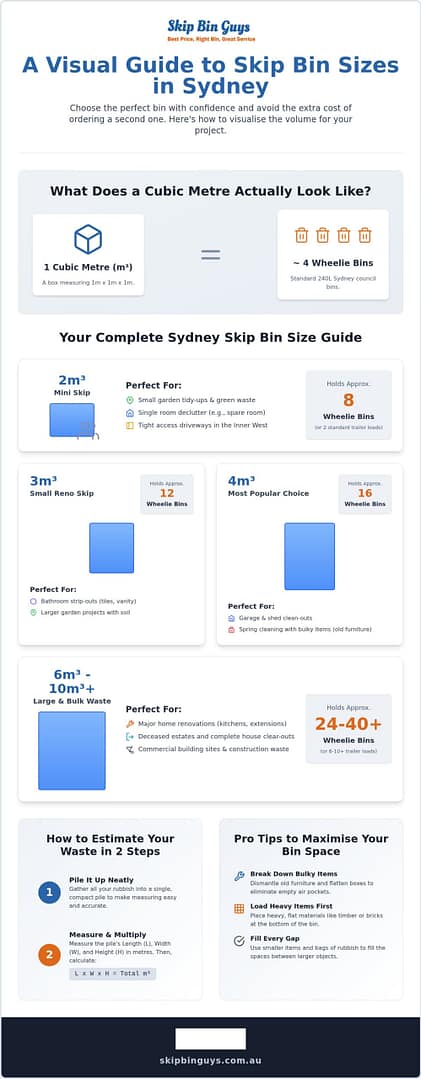
Ever wondered why the waste industry speaks in “cubes” instead of kilograms? In Australia, the cubic metre (m³) is the universal unit for waste measurement. To visualise this, imagine a box that’s exactly one metre high, one metre wide, and one metre deep. That is 1m³. When you’re comparing skip bin sizes Sydney providers offer, this measurement is your best friend. It helps you calculate volume regardless of whether you’re tossing out heavy bricks or light packing materials.
One common trap is forgetting about “air space.” If you toss a bulky, intact armchair into a bin, it might take up 1.5m³, but most of that volume is just the empty air under the legs and inside the frame. To get the best value, you want to fill that space with smaller items. Understanding this visual “box” method is the first step in ensuring you don’t overpay for a bin that’s mostly empty or end up with a pile of rubbish still sitting on your lawn after the truck leaves.
The Wheelie Bin Benchmark
The easiest way to wrap your head around these numbers is to look at your kerbside. Most Sydney households use a standard 240-litre wheelie bin, usually the one with the red lid. It takes approximately four of these bins to fill just one cubic metre. If you’re looking at a 2m³ “mini skip,” you’re essentially hiring the equivalent of eight wheelie bins. We find that 2m³ is usually the minimum size needed for a proper household declutter. Anything smaller and you’ll likely find yourself playing a frustrating game of Tetris to make it all fit. Want to calculate your pile before you call? Use this simple formula: multiply the length x width x height of your rubbish stack. For example, a pile that is 2 metres long, 2 metres wide, and 1 metre high equals 4m³.
Trailer Loads vs. Skip Bins
For many DIYers, the “tradie standard” 6×4 box trailer is the go-to comparison. Typically, a standard 6×4 trailer filled level to the top rail holds about 0.7m³ to 1m³ of waste. This means a 4m³ skip bin replaces four full trailer loads. When you choose a 6m³ bin, you’re saving yourself six separate trips to the local transfer station. While a trailer might seem cheaper at first, you have to factor in the hidden costs. The time spent driving across Sydney traffic, the petrol consumed, and the repeated tipping fees quickly add up. To avoid surprises on your final invoice, it’s worth understanding skip bin hire prices Sydney residents actually pay, including NSW Waste Levy rates and council permit fees. Hiring a skip allows you to focus on the project itself while we handle the heavy lifting and transport to EPA-approved recycling yards.
Small Skip Bins (2m³ to 4m³): Perfect for the Weekend Tidy-Up
For many residents, selecting the right skip bin sizes Sydney providers offer comes down to balancing capacity with physical space. If you’re tackling a backyard refresh or clearing out a spare room, a 2m³ “Mini Skip” is often the perfect starting point. These compact bins are designed to fit into driveways where larger trucks simply can’t reach, making them a staple for homeowners in the Inner West or Eastern Suburbs. They offer a neat, contained way to manage rubbish without dominating your entire property.
Residential Spring Cleans and Decluttering
What can you actually fit in a 2m³ bin? Typically, it holds about 8 to 10 large bin bags or a single small sofa. It’s the ideal choice for a light garden tidy-up. However, if you’re clearing out a garage full of years of accumulated “treasures,” the 4m³ bin is the most popular choice. It gives you that extra breathing room to dispose of larger items like old bicycles or broken shelving. When managing green waste, remember to cut branches into smaller lengths. This simple step prevents “bridging,” where branches create empty pockets at the bottom, helping you avoid overfilling. For a deeper dive into home projects, check out our Residential Skip Bin Hire Sydney guide.
Small Scale Renovations
Are you planning a bathroom update? A 3m³ bin is usually sufficient for a standard bathroom strip-out, including tiles, the old vanity, and the shower screen. Be mindful of weight, though. If your project involves heavy materials like dirt, bricks, or concrete, you must specify this when booking. Small skips have weight limits for safety and transport regulations, and exceeding these can lead to collection issues. In suburbs like Balmain or Paddington, where narrow driveways and terrace houses are the norm, these smaller bins are essential. Their footprint is minimal, which is a huge advantage when space is at a premium. If you’re unsure if a truck can navigate your narrow lane way, our expert team can help you choose the size over the phone to ensure a smooth delivery.
Medium to Large Bins (6m³ to 10m³+): Tackling Renovations and Construction
When your project moves beyond a simple weekend declutter, you’ll need to look at the more substantial skip bin sizes Sydney residents typically hire for major works. The 6m³ bin is widely regarded as the “Renovator’s Workhorse” because it strikes the perfect balance between high capacity and a manageable footprint. However, for deceased estates or full-scale commercial de-fits, jumping up to an 8m³ or 10m³ bin is often the smarter financial move. It’s much more cost-effective to hire one large bin than two smaller ones, provided you have the physical space to park it.
Before you book that 10m³ giant, take a tape measure to your driveway. These bins are roughly 4.5 to 5 metres long. You also need to account for the truck’s clearance; our drivers need enough room to safely extend the hydraulic arms and place the bin without hitting carports or low-hanging branches. If your driveway is tight, we might suggest two 4m³ bins instead to ensure we don’t damage your property or block your access entirely. Our team can help you navigate these logistics to find the right fit for your site.
Major Home Renovations and Extensions
Planning a new kitchen? A total gut-out of cabinetry, old appliances, and plasterboard usually requires at least 6m³. If you’re also ripping up old tiles or floorboards throughout the house, volume adds up quickly. Be careful with the “Heavy Waste” rule, though. While we offer Construction Skip Bin Hire Sydney services for heavy materials, very large bins (over 6m³) often have strict weight limits for pure concrete or brick. This isn’t just our rule; it’s a critical safety requirement for the trucks lifting them on Sydney’s roads.
Commercial and Construction Site Requirements
How to Estimate Your Waste Volume Like a Pro
Don’t leave your project’s success to a lucky guess. While we’ve already compared skip bin sizes Sydney locals often use to wheelie bins and trailers, the most accurate way to choose is to measure your actual rubbish. Before you book, follow this simple five-step process to ensure you get the right capacity every time.
- Step 1: Create a dedicated “waste pile” in your yard or garage. Having everything in one spot makes it much easier to visualise the total volume.
- Step 2: Measure the pile using a tape measure. Multiply the Length x Width x Height to get the raw cubic metres.
- Step 3: Add a 20% “fluff factor.” This accounts for air pockets created by awkward shapes, like old furniture legs or tangled branches, which prevent items from sitting flush.
- Step 4: Categorise by weight. Is your pile mostly “General Waste” like clothes and cardboard, or is it “Heavy Waste” like dirt, bricks, or concrete?
- Step 5: If your calculation sits right on the border between two sizes, always choose the next size up.
The “Next Size Up” Strategy
Ordering a 4m³ bin from the start is significantly cheaper than ordering a 2m³ bin and realising halfway through that you need a second one. When you factor in the cost of a second delivery and the additional tipping fees, you can easily save A$100 or more by estimating accurately the first time. The only exception to this rule is when you have strict physical constraints. If your narrow Paddington driveway can only fit a 2m³ bin, or if your local council permit limits the bin’s footprint on the nature strip, you might be forced to stick to the smaller size. If you’re stuck on the border of two sizes, contact our expert team to discuss your specific waste types and get a professional recommendation.
Weight vs. Volume: The Trap for Beginners
Density is just as important as volume. A common mistake is assuming that because a bin is large, it can carry anything. For example, a 10m³ bin filled to the brim with wet soil or solid concrete is often illegal to transport. The sheer weight would exceed the safe lifting capacity of the truck’s hydraulic arms and violate NSW road axle weight limits. For heavy materials like dirt, sand, or bricks, we usually recommend smaller, dedicated bins. Sydney builders often save money by splitting their waste: using a small bin for heavy masonry and a larger bin for light timber and packaging. This approach avoids “overweight” surcharges and ensures your waste is easier to sort at the recycling yard. For a full breakdown of what drives these costs, our guide to skip bin hire prices Sydney homeowners and builders pay covers weight limits, tipping fees, and how to avoid unexpected charges.
Sydney Council Rules and Access: Why Size Matters for Placement
Choosing between the various skip bin sizes Sydney providers offer isn’t just about how much junk you have; it’s also about where that bin is going to sit. If you can’t fit the bin entirely on your private property, you’ll likely need to use the nature strip or the road. This is where local council regulations come into play. Most Sydney LGAs require a formal permit for any bin placed on public land, and the size of your bin can directly impact the cost of that permit. Larger bins take up more “kerbside real estate,” which often results in higher daily fees or stricter placement conditions.
Another critical factor is what’s happening above the bin. Sydney is famous for its leafy streets and low-hanging power lines. A truck delivering a 10m³ bin needs significantly more vertical clearance than one dropping off a 2m³ mini skip. If your street is lined with heritage figs or low-slung cables, a smaller bin might be your only legal option. We’ve spent over 13 years helping locals navigate these specific LGA requirements, ensuring you don’t get hit with a surprise fine for incorrect placement.
Placing Your Skip on the Nature Strip or Road
Every council has its own quirks. For instance, the City of Sydney has very different rules compared to the Northern Beaches or Parramatta regarding how long a bin can stay on the road. A key rule of thumb is the “Permit Lead Time.” You should aim to book your bin at least 3 to 5 days in advance if it’s going on public land. This gives the council time to process the paperwork. Additionally, for safety, larger bins placed on the road often require reflective tape or even flashing amber lights to ensure they’re visible to traffic at night. Failing to meet these safety standards can make you liable for heavy fines if an accident occurs. Before you finalise your booking, it’s worth understanding how long can you keep a skip bin on public land under your council’s specific permit terms, as hire periods and daily extension fees vary significantly across Sydney LGAs.
Tight Access and Narrow Driveway Solutions
Do you have a narrow driveway in a suburb like Surry Hills or Redfern? The physical dimensions of the bin are only half the story; you also need to consider the truck. We use Marrel trucks, which are designed to lift bins vertically. This is a huge advantage in narrow Sydney streets where there isn’t room to roll a bin off a trailer. Before booking, measure your gate width. Our drivers typically need at least 3 metres of clearance to safely navigate a driveway. If your access is truly impossible, we can discuss alternative solutions, such as crane-lift bins that can be hoisted over a fence. Getting the logistics right from the start saves you time and ensures your project stays on track.
Ready to Clear the Clutter with Confidence?
Choosing the right capacity doesn’t have to be a guessing game. By visualising your waste in cubic metres and accounting for that crucial 20% “fluff factor,” you’ve already taken the biggest step toward a stress-free project. Whether you’re navigating a narrow Paddington lane way with a mini skip or managing a major site de-fit, understanding the skip bin sizes Sydney councils and streets accommodate ensures you avoid double-handling or unexpected fines.
With over 13 years of local experience, our team is here to make your waste management seamless. We prioritise the environment by using EPA-approved recycling yards, helping to keep Sydney green while you clear your space. If you’re ready to get started, we even offer a same-day delivery guarantee for orders placed before 10:30 am. There’s no need to let rubbish pile up when the solution is just a few clicks away.
Book Your Sydney Skip Bin Online Now and let us handle the heavy lifting. You’ve got the plan; now it’s time to reclaim your space and get that project finished!
Frequently Asked Questions
What is the most popular skip bin size for a house clean-out in Sydney?
The 4m³ bin is the most popular of the skip bin sizes Sydney homeowners choose for a standard house clean-out. It provides the ideal balance between capacity and physical footprint, holding the equivalent of 16 red-lid wheelie bins. This size is usually enough to clear out a cluttered garage or a couple of spare rooms without taking up your entire driveway.
Can I put a large 10 cubic metre skip bin on the road in Sydney?
You can place a 10m³ bin on the road, but you’ll almost certainly need a council permit first. These larger bins take up significant kerbside space, so councils have strict rules about where they can sit to ensure they don’t block traffic or visibility. It’s essential to check your specific LGA’s guidelines for “heavy vehicle” placement before booking to avoid unexpected fines.
How do I know if I need a 2m or 4m skip bin for my garden waste?
A 2m³ bin is perfect for small refreshes like hedge clippings, but a 4m³ bin is better for clearing overgrown backyards. Garden waste is notoriously difficult to pack tightly because branches and shrubs create large air pockets. If you’re removing large palm fronds or thick branches, the extra volume of a 4m³ bin prevents the frustration of an early overflow.
Is it cheaper to hire one large bin or two small ones?
Hiring one large bin is almost always more cost-effective than ordering two smaller ones. Every delivery involves transport costs, fuel, and administrative time, so consolidating your waste into a single 6m³ bin instead of two 3m³ bins saves you significant money. As long as you have the space on your property to accommodate it, going bigger from the start is the smarter financial choice.
What happens if I overfill my skip bin past the rim?
If you fill a bin past the rim, our drivers cannot legally transport it due to NSW road safety regulations. Items sitting above the top edge are at risk of falling out during transit, which is a major hazard for other motorists. If your bin is overfilled, you’ll need to remove the excess waste before we can collect it, which can result in additional call-out fees.
How much weight can a 6 cubic metre skip bin hold?
A 6m³ bin’s weight limit depends on whether you’re loading general household items or heavy masonry. While it can hold a substantial volume, filling a 6m³ bin entirely with solid concrete or wet soil can exceed the safe lifting capacity of the truck’s hydraulic arms. For very heavy materials, we often recommend using smaller bins to ensure we can safely lift and transport the load.
Do I need a permit for a small skip bin on my own driveway?
No, you don’t need a permit if the bin is placed entirely within your private property. Council permits are only required when the bin sits on public land, such as the nature strip, the footpath, or the road. Placing the bin on your driveway is the simplest way to avoid the extra cost and paperwork associated with local council applications.
Are there different sizes for “dirt only” skip bins?
Yes, we offer specific skip bin sizes Sydney builders use for “dirt only” loads, generally ranging from 2m³ to 6m³. Because soil is incredibly dense and heavy, we don’t provide the larger 8m³ or 10m³ bins for pure dirt. This ensures the truck can legally and safely lift the bin without violating NSW axle weight limits or damaging our equipment. If you’re planning a longer project and want to understand how long can you keep a skip bin on site for excavation or landscaping work, our 2026 Sydney hire guide covers standard hire periods and extension options in detail.