
Did you know that just one cubic metre of damp Sydney clay weighs roughly the same as a small car? When you’re staring at a pile of garden dirt or a smashed-up concrete driveway, it’s easy to underestimate the sheer physics involved in moving it. You’re likely worried about those hidden “heavy waste” surcharges or feeling confused by the strict rules surrounding different waste types. It’s a common stress, especially when you’re trying to figure out if your driveway can even handle the pressure of a loaded bin.
Securing the right skip bin for soil and concrete Sydney projects requires more than just picking a metal box; it’s about understanding how material purity affects your final bill. We want to help you master the rules of heavy waste disposal so you can avoid contamination fees and keep your project on track. This guide breaks down the 2026 price-to-weight ratios, explains the critical difference between “Clean Fill” and “Mixed Heavy” loads, and shows you how to avoid council fines for incorrect placement.
Key Takeaways
- Learn why choosing the right category, like Clean Fill or Mixed Heavy, is the secret to avoiding unexpected contamination surcharges on your project.
- Discover how to protect your driveway from heavy loads by using simple tools like tarps or plywood before your bin arrives.
- Understand the specific weight limits for a skip bin for soil and concrete Sydney residents use, including why larger bins aren’t always suitable for heavy materials.
- Master the art of loading your skip by placing the heaviest concrete pieces at the bottom to ensure maximum stability and safety.
- Find out how to take advantage of same-day delivery and 13 years of local expertise to keep your Sydney renovation moving without delays.
Understanding Heavy Waste: Why Soil and Concrete Need Special Bins
What exactly is heavy waste? In the Sydney skip hire industry, this term refers to materials with high density that quickly reach a truck’s lifting limit. Unlike household rubbish, which is mostly air and light packaging, materials like soil and concrete are incredibly heavy. To understand the waste container terminology used locally, a “skip” is specifically designed to handle these massive loads without buckling. When you hire a skip bin for soil and concrete Sydney residents often find that even a small 2 cubic metre bin can weigh several tonnes once filled.
Density is the main reason these materials need dedicated bins. While a cubic metre of kitchen scraps might weigh around 150kg, the same volume of wet Sydney clay can exceed 1.5 tonnes. If you mix these heavy items with general waste, it makes recycling difficult and expensive. Using EPA-approved recycling yards ensures that your heavy waste doesn’t just sit in a landfill. Instead, it gets processed into new materials, which is a win for both your wallet and the environment. Achieving high material purity is the secret to keeping your disposal costs down.
The Difference Between Dirt, Soil, and Fill
Is your waste just “dirt”? Not necessarily. In the waste industry, we distinguish between topsoil and Virgin Excavated Natural Material (VENM). Clean fill must be pure soil, free from organic matter like grass, roots, or branches. If your soil contains these items, it’s no longer “clean” and can’t be processed as easily. We also look out for “hot” soil, which might be contaminated from old industrial sites. Keeping your soil pure is the fastest way to lower your disposal costs and avoid contamination fees.
Why Concrete is a Recyclable Asset
Did you know your old driveway could become part of a new Sydney motorway? Concrete is a fantastic recyclable asset. Once collected, it’s taken to specialised facilities where it’s crushed into road-base or aggregate. For this process to work efficiently, the concrete usually needs to be “clean,” meaning it’s free from excessive rebar or steel mesh. By keeping your concrete separate from other waste types, you help support a circular economy and often pay less than you would for a mixed heavy load. It’s a simple way to stay environmentally responsible while finishing your project.
Clean Fill vs Mixed Heavy Waste: Choosing the Right Category
Choosing the wrong waste category is the fastest way to blow your renovation budget. In Sydney, waste facilities are incredibly strict about what enters their gates. If you’re organising a skip bin for soil and concrete Sydney projects, you’ll need to decide between “Clean Fill” and “Mixed Heavy.” The difference essentially comes down to the NSW EPA waste levy, which in 2026 sits at $180.20 per tonne for the Sydney metro area. Clean fill is cheaper because it bypasses much of this cost through direct recycling. If even a small amount of green waste or plastic ends up in a clean fill bin, the whole load gets reclassified, and you’ll be stuck with the higher “mixed” rate plus potential contamination fees.
Safety is also a major factor in how you categorise your waste. Regardless of the category you choose, some items are strictly off-limits. Asbestos, liquids, paints, and chemicals must never enter a standard skip. In 2026, fines for improper waste placement or hazardous disposal in Sydney can reach $2,500 for individuals. Before you start digging, it’s a great idea to organise your hire with a team that knows the local tips inside out. This ensures you’re set up for success from day one.
When to Choose a Clean Fill Bin
A clean fill bin is your best friend when you have a single, pure waste stream. Imagine you’re tearing up a standard concrete driveway. If that’s the only material going in, a 100% concrete bin is the way to go. The same applies to yard levelling where you’re only removing virgin soil. You must enforce a strict “no-mix” rule with your contractors. One stray bag of lunch rubbish or a handful of garden weeds can ruin the “clean” status of the entire bin, leading to those dreaded surcharges.
The Benefits of Mixed Heavy Waste Bins
How much can a skip truck actually lift? This is the most critical question when you’re booking a skip bin for soil and concrete Sydney wide. Most residential skip trucks in our city have a maximum lifting capacity of around 8 to 10 tonnes. While that sounds like a lot, a 4 cubic metre bin filled with wet soil can easily push those limits. Because one cubic metre of concrete weighs approximately 2,400 kg, filling a large 10 cubic metre bin with it would result in a load weighing 24 tonnes. No standard truck could lift that, which is why you’ll rarely see bins larger than 6 cubic metres offered for 100% concrete loads.
Before the truck arrives, you’ll need to assess your driveway’s strength. Can it handle a 6-tonne skip bin sitting on it for a week? If you have thin pavers or decorative stencilled concrete, you might want to consider placing the bin on the road or nature strip instead. However, this move requires a council permit. In 2026, Sydney council permit fees typically range from $50 to $200. For example, the City of Sydney currently charges $150, while the Northern Beaches Council is around $120. Placing a bin on public land without a permit is a risky move, with fines often exceeding $1,000.
Bin Sizes for Soil and Concrete
Which size is right for your project? The 2m³ “Mini Skip” is perfect for small garden paths or a few patches of old soil. For larger driveway replacements, the 4m³ and 6m³ “Heavy Skips” are the industry standard. These sizes are specifically engineered to hold the weight of dense materials while remaining within the legal lifting limits of the truck. Remember, filling a large bin with concrete is a recipe for a “non-lift” event. If the truck can’t safely hoist the bin, you’ll be left with a heavy problem and extra transport costs.
Navigating Sydney’s Narrow Streets
Sydney’s older suburbs are famous for their charm but notorious for their narrow streets. You’ll need to ensure there’s enough clearance for a large truck to manoeuvre. Are there overhanging gum trees or low-hanging power lines near your property? A standard truck needs a clear, wide path to drop and retrieve the bin safely. If you’re unsure about the local rules or how to manage the paperwork, check out our Sydney Skip Bin Permits: The Complete 2026 Guide for a suburb-by-suburb breakdown. We’ve helped locals navigate these logistical hurdles for over 13 years, making the process as smooth as possible.
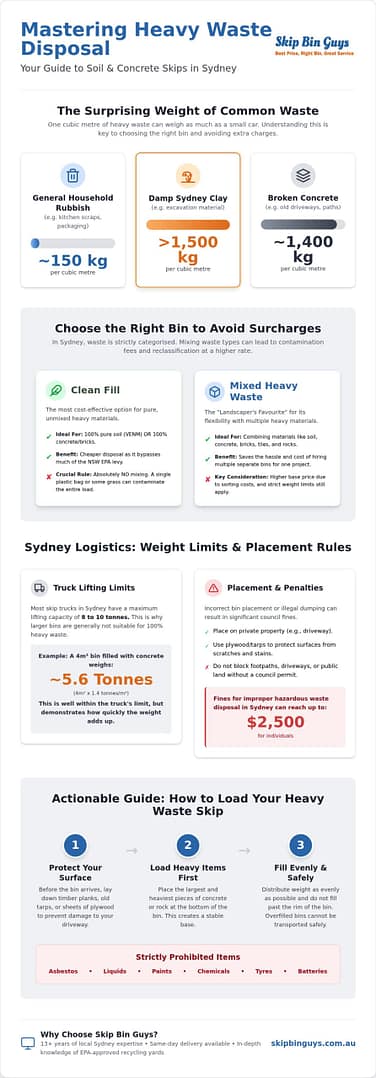
Actionable Guide: How to Load Your Heavy Waste Skip
Loading your skip bin for soil and concrete Sydney projects effectively is about more than just muscle. It’s a strategic process that ensures safety, protects your property, and helps you get the most value out of your hire. If you simply toss materials in without a plan, you’ll end up with air pockets that waste space and a load that might be unsafe to transport. Follow these five steps to load like a pro:
- Step 1: Protect the surface. Before the truck arrives, place a large tarp or sheets of thick plywood on your driveway. This creates a buffer that prevents scratches and helps distribute the weight.
- Step 2: Heavy items first. Place your largest concrete chunks at the very bottom. This lowers the centre of gravity, making the bin much more stable during the lift.
- Step 3: Fill the gaps. Once the concrete is down, use your soil or dirt to fill the voids between the chunks. This “sand-filling” technique ensures you aren’t paying for a bin full of air.
- Step 4: Keep it level. Your load must be flush with the rim. Resist the urge to use “greedy boards” (timber offcuts used to extend the bin’s height), as these are illegal for transport.
- Step 5: The final sweep. Double-check that no prohibited items like tree stumps, plastic bags, or general rubbish have snuck in. These will trigger contamination fees at the recycling yard.
Protecting Your Property
Nobody wants a “cracked driveway syndrome” after their renovation is finished. When a skip is filled with several tonnes of soil, the pressure on your concrete or pavers is immense. Beyond using plywood, you need to ensure there’s enough room for the truck’s stabiliser legs to extend fully. These legs take the brunt of the weight during the lift and need a solid, flat surface to work correctly. Don’t be afraid to have a quick chat with our driver about the precise placement. They’ve seen every type of Sydney driveway and can offer the best advice on the spot. If you’re ready to get started, you can order your heavy waste skip today and experience our friendly local service.
Avoiding the Overfill Fine
Why are we so strict about the “rim rule”? It’s a legal requirement. NSW transport regulations forbid drivers from carrying loads that aren’t securely contained within the bin’s walls. If a driver attempts to transport an overfilled bin, they risk heavy fines and demerit points. To avoid being left with a pile of excess dirt on your lawn, try to estimate your volume carefully before booking. If you’re unsure about the best bin size for your budget, our Skip Bin Hire Prices Sydney: The Complete 2026 Cost & Value Guide provides a detailed breakdown of how to choose the right capacity for your specific project.
Why Choose Skip Bin Guys for Your Sydney Project?
Why do Sydney renovators and tradies keep coming back to us? It’s because we understand the unique rhythm and challenges of this city. When you book a skip bin for soil and concrete Sydney wide, you need a partner who knows the difference between a tight Balmain terrace lane and a wide Kellyville driveway. With over 13 years of local experience, we’ve navigated every council quirk and narrow suburban street imaginable. We pride ourselves on a “can-do” attitude that takes the logistical stress off your shoulders so you can focus on the actual work.
Speed is often the name of the game when you’re mid-dig. If you realise your pile of dirt is twice as big as expected, you don’t want to be waiting days for a solution. That’s why we offer same-day delivery for Sydney orders placed before 10:30 am. We’re local, we’re efficient, and we’re dedicated to keeping your project moving. Finding a reliable skip bin for soil and concrete Sydney service shouldn’t be the hardest part of your build; with us, it’s the easiest.
Our Commitment to Recycling
Our dedication to the environment is at the core of everything we do. We don’t just dump your waste; we manage it responsibly by using EPA-approved recycling yards for every single load. This ensures that your old concrete is crushed for use in new road-base projects and your soil is screened and repurposed rather than ending up in landfill. This socially responsible approach gives you peace of mind that your home improvement isn’t coming at a high environmental cost. For more detailed insights into managing site waste, take a look at our Construction Skip Bin Hire Sydney: The 2026 Builder’s Guide.
Reliability You Can Bank On
Get Your Sydney Heavy Waste Project Moving Today
Managing a heavy waste project doesn’t have to be a logistical headache. By now, you’ve learned how material purity can save you from unexpected contamination fees and why understanding truck lifting limits is essential for a smooth collection. Whether you’re opting for a clean fill bin or a mixed heavy load, the secret is in the preparation. Protecting your driveway and getting your council permits sorted in advance will ensure your project stays on schedule and within budget.
Choosing a skip bin for soil and concrete Sydney residents can rely on means partnering with experts who understand local rules. With over 13 years of experience and a commitment to using EPA-approved recycling yards, we’re here to help you get the job done right. If you need a bin in a hurry, we offer same-day delivery for orders placed before 10:30 am. Our friendly team is ready to support your next renovation or landscaping project.
Book your Sydney heavy waste skip bin today and let us handle the logistics while you focus on the build. We’re excited to help you transform your space with a hassle-free waste solution.
Frequently Asked Questions
Can I mix soil and concrete in the same skip bin in Sydney?
Yes, you can certainly mix them, but this reclassifies your load as “Mixed Heavy Waste” rather than “Clean Fill.” While this is a convenient option for backyard renovations, it generally costs more to process at recycling centres. If you have large, pure quantities of either material, hiring separate bins for each is often the most cost-effective way to manage your project’s heavy waste disposal.
What happens if my soil and concrete bin is too heavy to lift?
If a bin exceeds the truck’s lifting capacity, typically between 8 and 10 tonnes, the driver cannot safely collect it. This results in a “non-lift” event where you’ll be required to remove enough material to meet the weight limit before we return. To avoid this stress and any additional transport fees, we recommend using multiple smaller bins for high-density materials like wet clay or thick concrete slabs.
Do I need a council permit for a heavy waste bin on the road?
You absolutely need a permit if any part of the skip bin sits on public land, such as the road or nature strip. In 2026, Sydney councils like the City of Sydney charge around $150 for these permits, and approval can take up to 10 business days. If you can place the bin entirely within your own property or driveway, no council permit or extra fee is required.
Can I put grass or turf in a clean fill bin?
No, clean fill bins are strictly for pure soil or Virgin Excavated Natural Material (VENM). Organic matter like grass, turf, and tree roots are considered contaminants in this specific waste stream. If these items are found in a clean fill load, the entire bin will be reclassified as mixed waste, which triggers higher disposal rates and potential contamination surcharges at the recycling yard.
How much notice do I need for a soil skip bin delivery in Sydney?
We offer same-day delivery for a skip bin for soil and concrete Sydney wide if you place your order before 10:30 am. While booking a few days in advance is great for planning, we know that Sydney projects can move at a fast pace. Our local team is dedicated to providing quick turnarounds to ensure your excavation work isn’t stalled by a lack of waste storage.
What is considered “contaminated” soil in the skip bin industry?
Soil is considered contaminated if it contains man-made debris like plastic, timber, or metal, or if it’s mixed with green waste. On a more serious level, soil containing chemicals, oils, or asbestos is strictly prohibited in any of our bins. We only accept non-hazardous heavy waste, which we then transport to EPA-approved facilities to ensure it’s recycled or disposed of in a socially responsible manner.
Can I put bricks in a concrete and soil skip bin?
Bricks are perfectly fine to include if you have booked a “Mixed Heavy Waste” bin. This category is designed for the variety of materials found during demolition and construction, including tiles, bricks, concrete, and dirt. Just keep in mind that the combined weight of these materials adds up very quickly. Always monitor the fill level to ensure the load remains flush with the rim for safe transport.
What is the largest bin size available for 100% concrete loads?
We generally limit bins for 100% concrete to a 6 cubic metre maximum size. Because concrete is incredibly dense, a full 6m³ bin weighs roughly 14 tonnes, which is the upper limit for most specialised skip trucks in Sydney. Attempting to fill a larger 10m³ bin with concrete would make it impossible to lift and could cause significant damage to your driveway or our equipment during collection.