
Did you know that overfilling your skip or placing it on a Sydney nature strip without the right permit can instantly add hundreds of dollars in unexpected costs to your project? We understand that renovating your home is an exciting milestone, but finding the right skip bin for renovation waste shouldn’t be the hardest part of the build. Between navigating the $174.20 per tonne NSW EPA waste levy and deciphering the specific permit rules for councils like Parramatta or the Inner West, it’s easy to feel overwhelmed by the hidden complexities of rubbish removal.
This guide will show you how to master waste management to keep your site safe, your costs low, and your conscience clear. You’ll learn how to sort materials at the source to avoid heavy-waste surcharges, select the perfect bin size for your specific debris, and stay on the right side of Sydney’s strict 2026 environmental regulations. We’ll even cover how to ensure your waste ends up in EPA-approved recycling yards to maximise material recovery and help NSW reach its ambitious 80% recycling target for construction waste. Let’s make your next renovation project as efficient and sustainable as possible.
Key Takeaways
- Learn how to slash your disposal costs by using a “sort-at-the-source” strategy to separate heavy masonry from lighter debris.
- Master the simple “trailer load” rule of thumb to accurately size your skip bin for renovation waste and avoid expensive overfill surcharges.
- Discover the professional loading sequence that maximises every cubic metre by layering flat materials first and breaking down bulky frames.
- Navigate 2026 Sydney council regulations with ease by knowing exactly when you need a permit for nature strip placement.
- Ensure your project stays environmentally responsible by utilising EPA-approved recycling processes that help meet NSW resource recovery targets.
Understanding Renovation Waste Types and Sorting
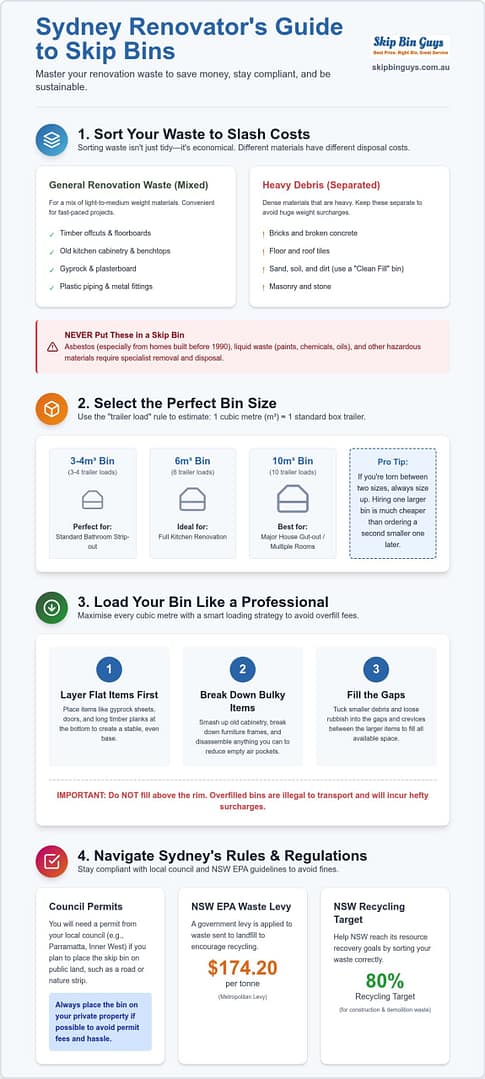
Getting your skip bin for renovation waste right starts with knowing exactly what you’re tossing into it. Renovation rubbish is rarely uniform; it’s usually a chaotic blend of light timber offcuts, dusty gyprock sheets, and heavy masonry from that old bathroom strip-out. A foundational grasp of Understanding waste management helps you see why sorting isn’t just about being tidy. It’s actually about project economics and staying compliant with local laws.
Sydney’s waste landscape is strictly regulated to meet the state’s ambitious 80% recycling rate for construction and demolition materials. Because of this, how you sort your debris directly impacts your bottom line. If you throw heavy bricks and concrete into a skip intended for light household items, you’ll likely face significant weight surcharges. Conversely, separating “Heavy Waste” like masonry into its own dedicated bin can often be cheaper because these materials are easier for recycling centres to process and reuse in road bases or new construction projects.
Choosing a “Mixed Waste” bin is often the most convenient path for a fast-paced home makeover. It allows you to combine various materials into one container, which saves space on tight Sydney sites. However, these bins require specific handling at EPA-approved facilities to ensure as much material as possible is recovered rather than sent to landfill, where the metropolitan levy currently sits at $174.20 per tonne.
General Renovation Waste vs. Heavy Debris
Distinguishing between light and heavy materials is the first step in a cost-effective cleanup. Light materials typically include timber offcuts, old kitchen cabinetry, floorboards, and plastic piping. These take up a lot of volume but don’t weigh much. Heavy materials are a different beast altogether. This category covers floor tiles, bricks, roof tiles, and concrete slabs. You should never mix soil or dirt with general renovation waste. Dirt is incredibly heavy and often requires its own “clean fill” bin to avoid massive transport fees and contamination issues at the tip.
Hazardous Materials: What Stays Out of the Skip
Safety is our top priority, and that means keeping hazardous items far away from a standard skip bin for renovation waste. In Sydney, the strict rules regarding asbestos are non-negotiable. If your home was built or renovated before 1990, there’s a high chance that materials like eaves, bathroom wall linings, or old vinyl tiles contain asbestos. These require specialist removal and cannot be placed in a regular skip under any circumstances.
Other prohibited items include liquid waste, chemicals, and half-full paint tins. These can leak and contaminate entire loads of recyclable masonry. You should also keep an eye out for older insulation materials. While modern glass wool is generally fine, older loose-fill insulation can sometimes be problematic and needs professional identification before disposal.
Choosing the Right Skip Bin Size for Your Project
How do you avoid the headache of a half-empty bin or, worse, a site overflowing with rubble? The most reliable way to estimate your skip bin for renovation waste is the “trailer load” rule. In the waste industry, one cubic metre (1m³) is roughly equivalent to one standard 6×4 box trailer filled to the rim. If you look at your pile of debris and see about four trailer loads of rubbish, a 4m³ bin is your target. It’s a simple mental shortcut that saves homeowners from the guesswork that often leads to project delays.
Selecting the right size isn’t just about convenience; it’s a savvy financial move. Many renovators make the mistake of hiring a small bin to save money, only to find they need a second one halfway through the job. Because a large portion of the cost involves the truck’s travel and fuel, hiring one 6m³ bin is significantly cheaper than hiring two 3m³ bins. If you’re torn between two sizes, we always recommend sizing up to ensure you have that extra breathing room for unexpected debris.
Estimating Cubic Metres for Common Reno Jobs
For a standard bathroom strip-out, which typically includes floor-to-ceiling tiles, a vanity, and a bathtub, a 3m³ or 4m³ bin is usually the sweet spot. Kitchens are slightly more complex because old cabinetry, benchtops, and bulky appliances like ovens or dishwashers occupy substantial volume. You’ll likely need a 6m³ bin to accommodate these awkward shapes without overfilling. If you’re tackling a full house gut-out involving multiple rooms and structural changes, stepping up to a 10m³ construction skip is the most efficient way to keep your site safe and tidy.
Weight Limits and Heavy Waste Considerations
It’s not just about the physical space; it’s about the lift capacity of the truck. Smaller skip trucks in Sydney have strict weight limits for safety. This is why heavy materials like concrete, bricks, and roof tiles require specialised heavy-duty bins designed to handle the strain. Following the NSW EPA rules for renovation waste ensures your heavy debris is transported legally and responsibly. Your weight limit significantly influences the final hire price because heavier loads incur higher disposal levies at the recycling gate. If you’re worried about fitting a large bin on a tight suburban street, you can check our local Sydney skip options to find a solution that works for your specific site layout.
Overfilling a bin is a risk you don’t want to take. If the waste exceeds the rim, it becomes a projectile hazard during transport, and drivers are legally required to refuse the pickup. This results in “dry run” fees and the extra labour of unloading the excess yourself. Stick to the fill line and you’ll keep your project moving smoothly and safely.
How to Organise Your Renovation Waste Like a Pro
Loading your skip bin for renovation waste effectively is the secret to getting the most value for your money. Think of it like a giant game of Tetris; if you leave large gaps, you’re essentially paying to transport Sydney air. A methodical approach ensures you fit every last scrap of debris into a single hire, avoiding the need for a second bin later in the project. It’s about being smart with the space you’ve paid for while keeping the job site safe for everyone involved.
Safety is just as important as space. You must keep the load level with the rim. If items poke out the top, the driver cannot legally or safely transport the skip on Sydney roads. This can lead to extra fees or the frustration of having to unload and re-pack your rubbish while the truck waits. By following a three-phase loading strategy, you’ll keep the site tidy and the transport safe.
The “Tetrising” Strategy for Maximum Space
Once the large items are in, use phase three to fill the remaining nooks and crannies. Smaller debris like tile offcuts, broken plaster, and general site rubbish should be used to plug the gaps between larger pieces. This creates a dense, stable load that won’t shift during transit. Placing heavy items at the bottom also ensures a stable centre of gravity for the skip truck, which is vital for safe navigation through Sydney’s narrower suburban streets.
Demolition vs. Installation Waste Management
The type of waste you produce changes as your project progresses. The demolition phase is the messiest, generating heavy masonry and structural timber. If your project involves major structural changes, you might find our ultimate guide to demolition waste disposal Sydney helpful for managing those larger volumes. During this stage, focus on keeping heavy materials separated to avoid unnecessary weight surcharges.
As you move into the installation phase, the waste profile shifts toward cardboard packaging, plastic wrap, and fine offcuts from new materials. This lighter waste is prone to blowing away, so try to pack it underneath heavier items or secure it within the bin. Following these packing tips is a key part of disposing of building waste responsibly, as it prevents litter and makes the eventual sorting at the recycling yard much more efficient.
Navigating Sydney Council Permits and EPA Rules
One of the most common questions we hear is: “Do I actually need a permit for my skip bin for renovation waste?” The answer depends entirely on where the bin will sit. If you can fit the skip entirely on your driveway or within your front yard, you don’t need a permit. However, if the bin needs to sit on the nature strip, the footpath, or a public road, a council permit is legally required. Skip Bin Guys simplifies this process by helping you navigate the paperwork, ensuring your project doesn’t hit a regulatory roadblock before the first tile is even lifted.
Sydney isn’t a monolith when it comes to waste regulations. Every local government area has its own rulebook and fee structure. For instance, a City of Sydney permit currently costs $150, while Woollahra Council charges $180. If you’re out west, Blacktown Council fees are more modest at $95. Our 13 years of local experience means we know which councils are strict on placement and which require specific safety markings, like reflective tape or flashing lights, to keep pedestrians safe after dark.
Permit Requirements for Sydney Suburbs
If your site lacks private space, placing a bin on public land requires careful planning. In 2026, most Sydney councils, including Parramatta and the Inner West, require between 3 and 5 business days for approval. You can’t simply drop a bin on the road and hope for the best; doing so risks fines that often exceed the cost of the skip hire itself. Some councils allow nature strip placement with protection like timber boards to prevent turf damage, while others insist the bin stays on the road to keep footpaths clear. For a detailed breakdown of your local rules, check our Sydney skip bin permits guide.
EPA Approved Waste Disposal in Sydney
Choosing EPA compliant skip bin hire Sydney isn’t just about being environmentally conscious; it’s about protecting yourself from legal liability. Under the chain of responsibility, you remain legally accountable for your waste’s journey from your front gate to the final processing facility. If an unlicensed operator fly-tips your renovation debris, the authorities can trace it back to you. By using EPA-approved recycling yards, we ensure your masonry and timber are processed to reduce landfill impact, helping Sydney reach its resource recovery targets. If you’re ready to clear your site legally and safely, book your skip with our Sydney experts today.
Why Skip Bin Guys is Sydney’s Top Choice for Renovators
Timing is everything when you’re coordinating trades and deliveries. If your site is becoming a safety hazard due to piling rubble, you need a solution fast. That’s why we offer same-day delivery across Sydney for all orders placed before 10:30 am. This rapid response ensures your site stays clean, safe, and compliant with OHS standards. Beyond speed, we’re deeply committed to the environment. Every load we collect is taken to EPA-approved recycling yards to maximise material recovery, ensuring your old bricks and timber are repurposed rather than buried in landfill.
Reliable Service for Every Sydney Project
Sydney’s geography presents unique challenges that out-of-town providers often struggle to handle. Our drivers are experts at navigating narrow suburban streets and backing into those tricky Inner West lanes that leave others scratching their heads. Whether you need skip bin hire Penrith or a specialised placement in a tight CBD driveway, our fleet is equipped with the right gear for the job. We stand behind our work with a satisfaction guarantee that applies to everyone from first-time DIYers to professional builders who rely on us for multiple sites every week.
Booking Your Renovation Skip in Seconds
We’ve stripped away the complexity of waste removal with a booking process that’s as simple as it is transparent. You don’t have to spend your lunch break on hold; our online system allows you to secure your skip bin for renovation waste in just a few clicks. On delivery day, you can expect clear communication and a driver who arrives when they say they will. We respect your property and your time, ensuring the bin is placed exactly where you need it to make loading as easy as possible. Ready to clear the clutter? Book your renovation skip bin now and let our friendly team take the stress out of your site cleanup.
Ready to Kickstart Your Sydney Home Transformation?
Managing a successful build is about more than just picking paint colours; it’s about keeping your site safe and your budget on track. By mastering the “trailer load” rule for sizing and separating your heavy masonry from general debris, you’ve already done the hard work to avoid those pesky surcharges. You now know exactly how to navigate 2026 council permit rules and ensure your waste is handled legally through EPA-approved channels. Choosing the right skip bin for renovation waste is the final piece of the puzzle that turns a chaotic demolition into a smooth, professional project.
With over 13 years of local expertise, we’re here to make sure your rubbish is the last thing on your mind. We offer same-day delivery for orders placed before 10:30 am, giving you more time to focus on the exciting parts of your renovation. Our dedicated team is ready to help you clear the decks while ensuring your materials are processed at EPA-approved recycling yards. Get a Fast Quote for Your Sydney Renovation Skip today and let’s get your project moving. You’ve got this, and we’re right behind you every step of the way!
Frequently Asked Questions
What size skip bin do I need for a bathroom renovation?
A 3m³ or 4m³ bin is the ideal size for a standard bathroom strip-out. This volume comfortably fits floor-to-ceiling tiles, the old vanity, and the bathtub without exceeding the fill line. If you’re also removing structural walls or large amounts of heavy masonry, consider sizing up to ensure you don’t need a second hire later. It’s the most efficient way to manage your bathroom debris.
Can I put old kitchen appliances in a renovation skip bin?
You can place most old kitchen appliances like ovens, cooktops, and dishwashers in a renovation skip. However, items like fridges or freezers often require special handling due to the gasses inside; it’s best to check with us first. Breaking down larger appliances where possible helps you maximise the space inside your skip bin for renovation waste. This ensures you get the best value from your hire.
Do I need a permit to put a skip bin on the road in Sydney?
You definitely need a council permit if the bin is placed on a public road, nature strip, or footpath in Sydney. Permits aren’t required for placement on private property like your driveway or front lawn. Each council, from Parramatta to the Inner West, has different fees and lead times. We recommend applying at least five business days before your delivery to avoid project delays.
How long can I keep the skip bin for my renovation project?
Our standard hire period is typically 7 to 10 days, which provides ample time for most demolition and cleanup phases. If your project hits a delay or you need the bin for longer, just give us a call to arrange an extension. We’re flexible and understand that renovation timelines can shift due to weather or trade availability. Clear communication helps us keep your site tidy and safe.
What happens if I accidentally put asbestos in the skip?
Stop work immediately and notify us if you find or accidentally place asbestos in a skip. Asbestos is strictly prohibited in standard bins due to severe health and safety risks. The entire load becomes contaminated. This requires specialised hazardous waste transport and disposal at an EPA-licensed facility, which carries significant additional costs. Safety is the top priority for your family, your neighbours, and our drivers.
Is there a weight limit for renovation waste bins?
Yes, every skip bin for renovation waste has a specific weight limit based on the truck’s lifting capacity and road safety regulations. Heavy materials like concrete, bricks, and soil are much denser than timber or gyprock. If you’re disposing of masonry, we’ll provide a heavy-duty bin specifically designed to handle the weight safely. Exceeding these limits can lead to extra transport fees or transport refusals at your gate.
Can I mix garden waste with my renovation debris?
You can mix garden waste with renovation debris in a mixed waste bin, but it’s often more expensive than a dedicated green waste skip. If you have a large amount of soil or branches, separating them into a different bin can save you money on disposal levies. Always ensure the green waste is free from contaminants like plastic, treated timber, or general building rubble to help with recycling.
How much notice do I need to give for same-day delivery in Sydney?
To secure same-day delivery in Sydney, you need to place your order before 10:30 am on a business day. This allows our drivers enough time to coordinate their routes and ensure your bin arrives when you need it. For peak periods like summer or long weekends, booking a day or two in advance is always a smart move to ensure your site stays clean and productive.