
What if moving day could start with fewer boxes and less last-minute sorting? If you’re searching for practical advice on decluttering house before moving Sydney, start early and give each item a clear next step.
It’s easy to feel overwhelmed when you’re sorting belongings alongside removalist bookings, packing and everyday life. If you live in an apartment or share your home, there may also be little room for sorting piles. You don’t need to clear everything at once or part with items you still value. A simple plan can make the process more manageable and help you pack and transport less.
This guide shows you how to work through your home in stages, decide what to keep, pass on, recycle or dispose of, and sort belongings when space is tight. You’ll also learn how to direct suitable unwanted household items to responsible disposal options, including skip bin hire, so you can move with a clearer plan.
Key Takeaways
- Start decluttering house before moving Sydney by choosing one manageable area and sorting belongings as you go, rather than shifting unsorted piles around.
- Use a simple keep, pass on, recycle or dispose system to decide the next step for each item.
- Match items to their condition and material so reusable belongings can be passed on and recyclable items directed to suitable options.
- Fit sorting around your move, allowing for apartment access, shared spaces and any building arrangements.
- A residential skip bin can help with suitable unwanted household waste; hazardous and liquid waste need separate handling.
Where should you start decluttering your Sydney home before a move?
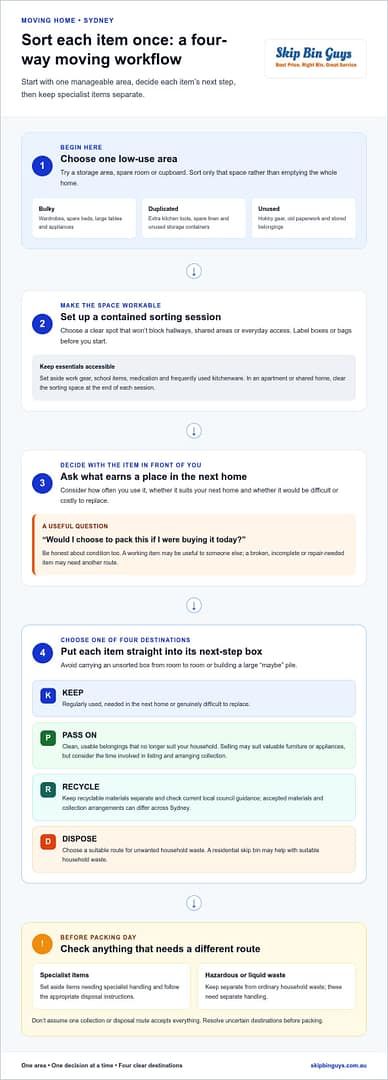
Moving can leave you juggling a long list of jobs while every cupboard seems to hold another decision. Start small: choose one low-use area, take stock and sort only that space. A practical approach to decluttering house before moving Sydney helps you make steady progress without turning the whole home into a maze of half-filled boxes and sorting piles.
Fewer belongings can mean less to pack, carry and unpack, as well as a clearer idea of what needs space in your new home. Begin with things you can manage without for now, rather than emptying the kitchen or packing clothes you wear every week. For an overview of different approaches, see Decluttering principles and methods, then adapt your process to the time and space you have.
Before you begin, make a quick room-by-room inventory. There’s no need to list every small possession. Note items that are bulky, duplicated or unused, and flag anything that could affect packing or moving arrangements.
- Bulky: wardrobes, spare beds, large tables and appliances.
- Duplicated: extra kitchen tools, spare linen or unused storage containers.
- Unused: hobby gear, old paperwork and belongings tucked away in storage.
This snapshot helps you spot the areas likely to take the most effort. It also brings forward decisions about large furniture and appliances, rather than leaving them until you’re planning how to move everything.
Which rooms and belongings should you sort first?
Start with storage areas, spare rooms and cupboards holding things you rarely use. These spaces often contain items you can sort without disrupting daily routines. Set aside everyday essentials, such as work gear, school items, medication and frequently used kitchenware, so they remain accessible until moving day. Flag bulky furniture and appliances early. Knowing what you plan to take helps you plan for packing and removal.
How can you make a realistic decluttering plan?
Break the job into short sessions, each with a clear focus, such as the linen cupboard or bookshelves. Choose a sorting spot that won’t block hallways, shared areas or access to everyday belongings. In an apartment or shared home, keep the work contained and clear the space at the end of each session. Starting early lets you spread decisions across the move instead of rushing them at the last minute.
How to sort belongings before moving house in Sydney
Once you’ve chosen what to tackle, make each decision while the item is in front of you. Avoid carrying an unsorted box from one room to another and postponing the same choices. Use four clear destinations: keep, pass on, recycle or dispose. Label boxes or bags before you begin, then put each item straight into the right one.
A useful rule is simple: Keep what earns its place in your next home, and give everything else a suitable next step. Consider how often you use an item, whether it will suit your next home and whether it would be difficult or costly to replace. Condition matters too. A working appliance may be useful to someone else, while a broken one may need a different destination.
For tricky decisions, ask yourself: Would I choose to pack this if I were buying it today? If the answer is no, consider whether it can be passed on, recycled or disposed of appropriately. Avoid creating a large “maybe” pile. If you’re genuinely unsure, limit the space or time you’ll give those decisions, then revisit them before packing.
What should you keep, donate or sell?
Keep belongings you use regularly, need for the next home or would find genuinely difficult to replace. Clean, usable items that no longer suit your household may be worth passing on, provided they’re in a condition someone else can use. Selling can make sense for valuable furniture or appliances, but factor in the time to photograph, list, arrange collection and manage enquiries. If the likely return doesn’t justify the effort, consider another suitable next step.
Be honest about condition. Stained linen, incomplete games or furniture needing repair may not be suitable to pass on, even if they once had plenty of life left. Don’t assume an item is reusable just because it technically works. A clear decision now helps prevent unwanted belongings from becoming one more thing to pack and transport.
How should you handle recycling and unwanted household items?
Keep recyclable materials separate and follow your local council’s current guidance, as accepted materials and collection arrangements can differ across Sydney. Some items need specialist handling, so set them aside and follow the appropriate disposal instructions rather than mixing them with ordinary household waste. Don’t assume one collection or disposal route accepts everything. For suitable unwanted household waste, residential skip bin hire may be a practical option; separate items needing specialist handling.
As you sort, note items whose destination needs checking and resolve that before packing day. This keeps the four-way system useful without forcing every item into a route that may not suit it. For decluttering house before moving Sydney, choosing the right destination matters more than simply getting an item out of sight.
Which decluttering options suit different Sydney household items?
Once you’ve decided an item won’t be moving with you, match its condition and material to a sensible next step. A clean, working item may be useful to someone else, while a damaged item or recoverable material may need a different route. Use this guide as a starting point, then check current acceptance rules for the organisation or service you plan to use.
| Item and condition | Possible next step |
|---|---|
| Clean clothes, books, kitchenware or furniture in usable condition | Offer to family or friends, donate through a reuse organisation, or sell selected items. |
| Working furniture or appliances with resale value | Consider resale if the likely return is worth the time needed to list and arrange collection. |
| Paper, cardboard, glass or other recyclable material | Separate it and follow your council’s current recycling guidance. |
| Electronics and batteries | Keep them apart from ordinary household rubbish and look for a suitable dedicated recycling option. |
| Broken, worn or unsuitable household items | Check whether a council collection or another disposal option accepts them; don’t assume every route takes all items. |
When are donation, resale or reuse suitable?
Passing on an item makes sense when it’s clean, complete and ready for someone else to use. Check the current acceptance requirements of the reuse organisation you choose, as condition and item policies can differ. Resale can suit selected furniture, appliances or other items with a clear second-hand appeal, but allow time for photos, messages and collection arrangements. If that effort outweighs the likely return, another reuse option may be simpler.
Be realistic about condition. An item needing extensive repairs or cleaning may not be suitable for donation, even if it still has some use. You can also offer good-quality belongings to someone you know, provided collection fits your moving schedule.
When should you check recycling or council collection guidance?
Check your Sydney council’s current guidance before putting items out for collection or sorting recyclables. Accepted materials, booking processes and collection limits can vary between council areas. Keep electronics, batteries and other items that may need dedicated recycling arrangements separate from general household waste, and follow the instructions for each.
If you’re considering a skip bin and it may need to be placed in a public area, read the Sydney skip bin permit guidance for information about council requirements. For decluttering house before moving Sydney, checking the destination first helps you avoid setting aside items for a collection that won’t accept them.
How to fit Sydney decluttering around your moving timeline
Decluttering works best as a moving task that progresses alongside packing, not as an all-at-once project. Build a flexible sequence around your move date and the practicalities of your home. Start with belongings you can do without, organise their next destination, then leave daily essentials until closer to moving day.
A simple sequence could look like this:
- Early in the move: Sort stored, seasonal and seldom-used belongings, such as spare linen, books or camping gear.
- As plans take shape: Arrange suitable donation, resale or recycling options, allowing time for collection or drop-off.
- As packing progresses: Review remaining rooms and keep everyday items available until you’re ready to pack them.
- Before the final clear-out: Confirm how items will leave the property and where they can wait without blocking access.
There’s no need to follow a rigid week-by-week schedule. Adjust the sequence to suit your availability, collection arrangements and access to your home. An apartment move may involve lift bookings, loading access or shared-space arrangements, while a shared home may require coordination with housemates about common areas.
What should you do before the final weeks of a Sydney move?
Use the earlier part of your moving lead-up for stored, seasonal and seldom-used belongings, leaving everyday necessities accessible. Give yourself time to organise donation, resale or recycling destinations rather than assuming they can happen at short notice. In an apartment, speak with the building manager or strata about move access and shared-space requirements, so collection plans fit the building’s arrangements.
Also check the relevant council’s current guidance if you’re considering a household collection or a bin that may need to be placed in a public area. Council arrangements differ, and knowing the process beforehand helps you plan where items can wait and when they need to be ready.
How can you keep the final clear-out manageable?
Keep important documents, medications, valuables and daily essentials together in a clearly marked area that won’t be mistaken for items being removed. Create a separate, labelled holding spot for belongings awaiting collection or disposal, and keep it contained so boxes and bags don’t spread into shared walkways. In a compact home, clear items from that spot regularly instead of letting it become another long-term pile.
Confirm access and disposal arrangements before the final clear-out. Planning ahead helps prevent last-minute uncertainty about where items can go or how they’ll be moved. If suitable household waste needs clearing as your move approaches, arrange residential skip bin hire as part of your disposal plan.
When can a skip bin help with decluttering before a Sydney move?
A residential skip bin can be a practical option when your clear-out leaves suitable household waste that’s bulky, awkward to carry or too much to manage through ordinary sorting. It gives you a way to gather those items for removal as you prepare to move. It isn’t a destination for everything in the house. Keep clean, reusable belongings aside for passing on, and separate items that need dedicated handling before deciding what to do with the remaining waste.
That distinction matters. Keep hazardous and liquid waste out of a skip bin and follow the appropriate handling or disposal guidance for each item. For other discards, check that the contents are suitable before adding them, rather than assuming every unwanted possession belongs in the same disposal stream.
Is a skip bin the right fit for your decluttering pile?
Consider a skip bin if you’ve already separated items worth keeping or passing on and are left with a sizeable amount of suitable unwanted household waste. Bulky discards can be difficult to manage in a compact apartment or shared home, so plan where they’ll be kept and how they’ll be accessed. For more detail on the process, read the guide to residential skip bin hire in Sydney.
Before the clear-out, check your pile: reusable items should stay out of it, and anything requiring separate handling should remain apart. This keeps your disposal plan focused on suitable household waste, rather than turning the bin into a catch-all for every item you no longer want.
What can you expect from Skip Bin Guys?
Skip Bin Guys has over 13 years of experience and provides friendly support throughout the hire process. The service covers delivery, hire, collection and waste processing, giving you a clear path for suitable household discards as you organise your move. Waste is processed at EPA-approved recycling yards to maximise material recovery.
Same-day delivery is available for orders placed before 10:30 am. If that suits your plans, build the bin into your moving schedule alongside your clear-out and access arrangements, so there’s a sensible place for suitable waste to go.
If a skip bin suits the items you’ve set aside, explore residential skip bin hire in Sydney to understand the service and plan your next step. With suitable items separated and arrangements made, decluttering house before moving Sydney can feel more orderly, right through to the final clear-out.
Make your next move feel lighter
A calmer move doesn’t depend on having a perfectly cleared home. It comes from making considered decisions early, so the belongings you take are the ones that genuinely belong in your next chapter. With a simple plan for decluttering house before moving Sydney, you can keep moving tasks manageable and spend less time dealing with unwanted items at the last minute.
If your final clear-out includes suitable household waste, a residential skip bin can help you manage it as one part of your moving plan. Skip Bin Guys has more than 13 years of experience, offers same-day delivery for orders placed before 10:30 am, and processes waste at EPA-approved recycling yards to maximise material recovery. Friendly support and a satisfaction guarantee are provided throughout the hire process.
Choose the next step that suits your home and the items you’ve set aside. For help with a household clear-out in Sydney, explore residential skip bin hire with Skip Bin Guys. A few thoughtful decisions today can help you start your next move with more breathing room.
Frequently Asked Questions
How far ahead should I declutter before moving house in Sydney?
Start as soon as your moving plans allow, and pace the work to suit your household. For decluttering house before moving Sydney, you might add a small sorting task to your calendar each week, such as checking one storage shelf or reviewing outgrown children’s items. The time needed depends on how much you own, your available hours and how quickly you can organise destinations for belongings you won’t take.
Should I declutter before getting a removalist quote?
What should I do with confidential paperwork before moving?
Separate confidential paperwork from general household items before packing, and keep important records in a secure folder you can access during the move. For papers you no longer need, use a secure destruction method rather than placing them in a box for donation or general reuse. If you’re unsure whether a financial, legal or personal record should be retained, check the relevant guidance before disposing of it.
Can I put old electronics in a skip bin in Sydney?
Don’t assume old electronics belong in a general waste bin. Set aside devices such as phones, computers and small appliances, then check your Sydney council’s current advice or a suitable electronics recycling option. Before passing on or recycling a device, remove personal information and sign out of accounts where possible. Keep batteries separate if the collection instructions call for it, and follow the specific directions for each item.
What should I do with leftover paint or household chemicals when moving?
Keep leftover paint, cleaning chemicals and similar products out of ordinary household rubbish and skip bins. Don’t pour liquids down a drain. Check your local council’s current guidance for the correct handling or collection option, and follow the product label while keeping containers secure and upright. If a container is leaking or its contents are unclear, avoid opening or mixing it, and seek appropriate handling advice before moving or disposing of it.
Can renters declutter a Sydney property before handing back the keys?
Yes, renters can sort and remove their own belongings, while leaving the property’s fixtures and supplied items in place. Check your tenancy documents and move-out instructions so you understand the expected handover condition. If you’re unsure whether something, such as a curtain, appliance or storage unit, belongs to you or came with the property, clarify ownership before removing it. Leave time to check cupboards, balconies and storage areas before returning the keys.